
Subtotal ₨ 0
Building a mobile app can be an exciting opportunity for a business, startup, or individual with a great idea. But before development begins, there is one question that almost everyone wants answered:
How much does a mobile app cost?
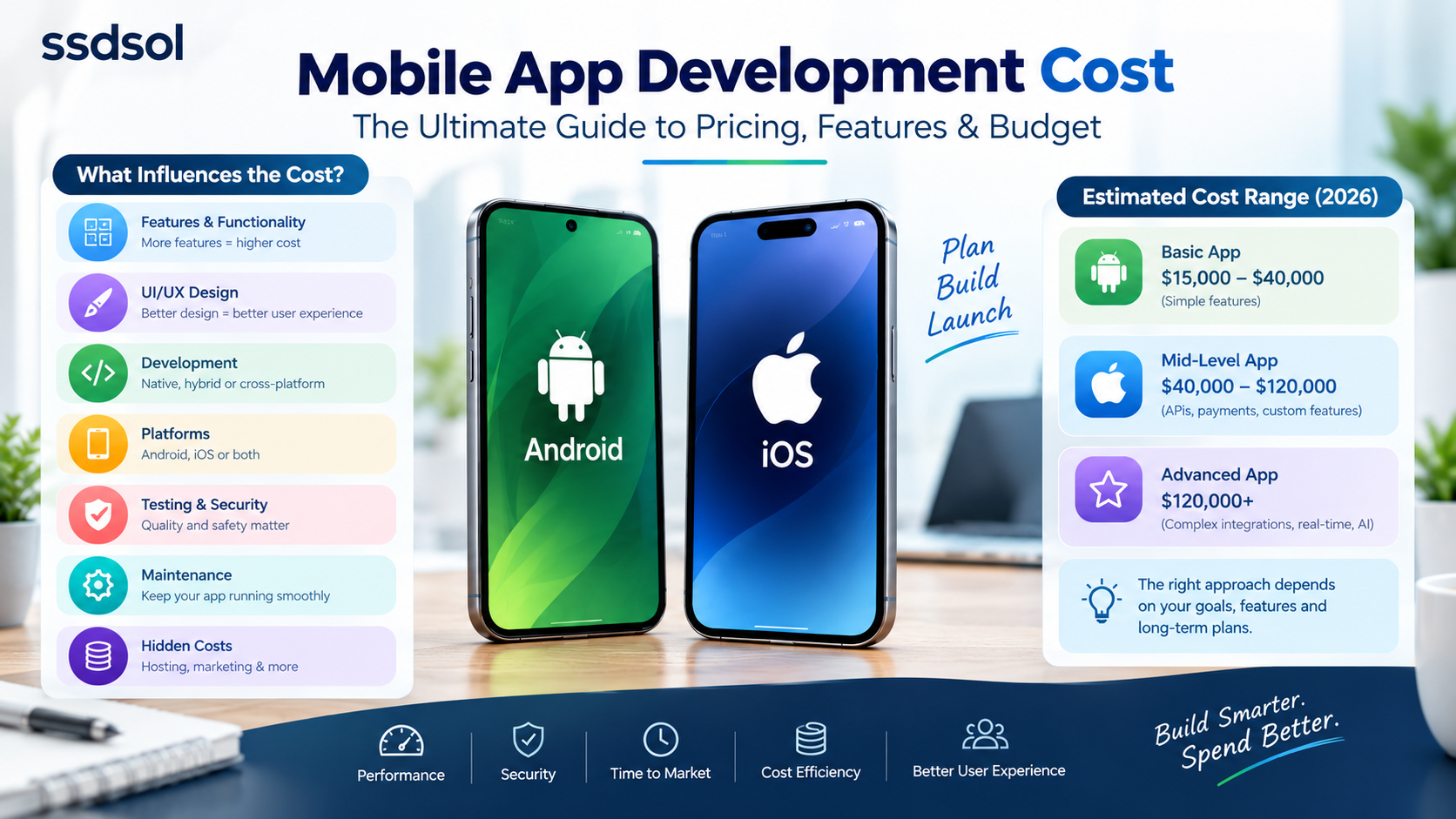
The truth is that there is no single price for building an app. Mobile app development cost can vary significantly depending on the app’s features, design, platform, development team, integrations, security requirements, and long-term maintenance.
Current 2026 industry estimates show a very wide range. GoodFirms reports that app projects can range from around $15,000 to $500,000+, depending heavily on complexity and requirements, while Clutch reports that many reviewed projects fall between $10,000 and $49,999. These figures are industry benchmarks rather than fixed prices for every project.
That is why understanding what actually drives the price is more useful than looking for one magic number.
In this guide, we will explain mobile app development cost from start to finish, including features, design, platforms, development, testing, maintenance, hidden expenses, and practical ways to control your budget.
How Much Does Mobile App Development Cost in 2026?
A useful way to think about app pricing is by complexity.
| App Type | Approximate Development Cost* | Typical Complexity |
|---|---|---|
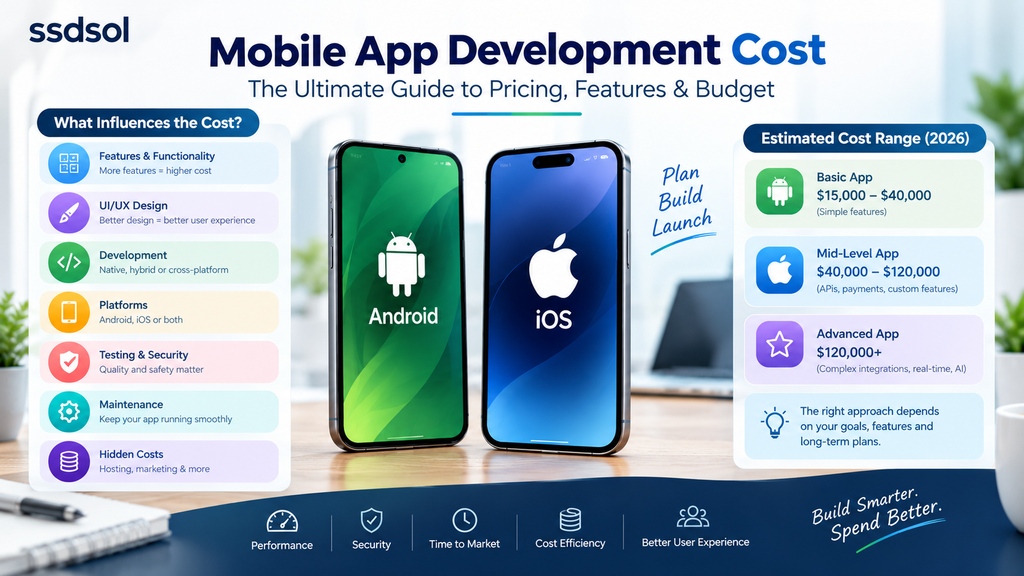
| Basic app | $15,000–$40,000 | Simple features and limited backend |
| Mid-level app | $40,000–$120,000 | APIs, payments, accounts and custom features |
| Advanced app | $120,000+ | Complex integrations, real-time features and advanced technology |
| Enterprise app | $200,000+ | Large-scale systems, security and complex infrastructure |
*These are broad industry estimates, not fixed quotations. Current published estimates vary substantially depending on region, team, scope, and technology. GoodFirms’ 2026 research, for example, places basic apps around $15,000–$40,000 and mid-level apps around $40,000–$120,000.
Clutch’s 2026 pricing guide reports that the average reviewed app development project was approximately $90,780, although most projects in its directory fall within a much broader range and individual project prices depend on scope.
So, instead of asking only “What is the average app price?”, it is better to ask:
What does my particular app need?
What Factors Affect Mobile App Development Cost?
Several elements can change the final budget. Understanding them early can prevent unpleasant surprises later.
1. App Complexity
Complexity is one of the biggest factors affecting mobile app development cost.
Basic Apps
A basic application might include:
- User registration
- Login
- Simple profile
- Static information
- Basic navigation
- Push notifications
- Simple database functionality
These applications generally require less development time.
Medium-Complexity Apps
A medium-level application may include:
- Social login
- Payment integration
- Search
- Filters
- User profiles
- APIs
- Push notifications
- Analytics
- Cloud database
- Real-time updates
As features increase, development and testing requirements also increase.
Advanced Apps
Advanced applications can include:
- Real-time messaging
- Artificial intelligence
- Machine learning
- Video streaming
- Advanced payment systems
- GPS tracking
- Complex dashboards
- IoT integration
- Augmented reality
- Large-scale databases
These projects require more specialized development and infrastructure.
2. Number of Platforms
The platform you choose can have a major effect on your budget.
You might build for:
- Android
- iOS
- Android and iOS
- Multiple platforms using a cross-platform framework
Building separate native applications for Android and iOS can require additional development work.
On the other hand, cross-platform technologies can allow teams to share a significant portion of their code. Apple also supports multiplatform projects where project settings and code can be shared across supported platforms.
However, cross-platform development does not automatically mean that every project will cost less. Platform-specific requirements, integrations, testing, and custom native functionality still affect the final budget.
3. UI and UX Design
A professional application needs more than functional code.
Users interact with the interface every time they open your app, so design plays an important role in both usability and development cost.
UI/UX work can include:
- Wireframes
- User journeys
- Prototypes
- Typography
- Colors
- Icons
- Navigation
- Responsive layouts
- Accessibility
- Interactive elements
A simple application with a standard interface may require relatively little design work.
A highly customized application with animations, illustrations, advanced navigation, and personalized experiences will require more time.
This is one reason two apps with similar basic functions can have very different development budgets.
4. Features and Functionality
Features are another major part of mobile app development cost.
For example, a simple appointment-booking app might require:
- Registration
- Login
- Doctor or service profiles
- Calendar
- Appointment booking
- Notifications
- Payment
- Admin panel
Adding features such as video consultations, electronic records, AI assistance, multilingual support, or complex reporting would increase the development requirements.
The best approach is to separate your features into two groups:
Must-have features
These are essential for the first version of your app.
Future features
These can be introduced after the initial launch.
This approach can help you build a practical minimum viable product (MVP) instead of spending your entire budget before you know how users respond.
5. Backend Development
The part of an app that users see is only one side of the project.
Many applications require a backend system to handle:
- User accounts
- Databases
- Authentication
- Payments
- APIs
- Notifications
- File storage
- Analytics
- Admin controls
- Business logic
For applications with significant backend requirements, this can become one of the largest components of the overall budget.
Current GoodFirms research estimates backend development at roughly 25–35% of development costs in its sample, although the actual percentage varies by project.
6. Third-Party Integrations
Modern apps rarely operate completely on their own.
You may need to connect your application with:
- Payment gateways
- Google Maps
- Social media platforms
- Email services
- SMS providers
- Cloud storage
- CRM systems
- Analytics platforms
- AI services
- Shipping systems
Every integration requires development, testing, authentication, and ongoing monitoring.
Some services also charge usage-based fees, which means the cost can continue after the application launches.
7. Security Requirements
Security becomes particularly important when an app handles sensitive information.
Examples include:
- Financial information
- Personal data
- Health information
- Passwords
- Payment details
- Business information
Security requirements can include encryption, secure authentication, access control, monitoring, testing, and compliance work.
An app that handles sensitive information may therefore require a larger budget than a simple content application.
8. Testing and Quality Assurance
Testing is sometimes overlooked when people calculate mobile app development cost.
A professional app needs testing before launch.
Testing may include:
- Functional testing
- UI testing
- Performance testing
- Security testing
- Compatibility testing
- Network testing
- Device testing
- Usability testing
- Regression testing
Testing is especially important when an app supports multiple devices and operating systems.
Clutch identifies testing as one of the standard services involved in a mobile application project, alongside discovery, planning, UI/UX, development, launch, and maintenance.
9. Developer Experience and Location
Who builds your app can significantly affect the budget.
You might work with:
- A freelancer
- A small development team
- A software development agency
- An in-house team
Developer experience and geographic location can also affect hourly rates.
For example, Clutch’s current pricing guide lists many app development companies at approximately $25–$49 per hour, while rates can vary considerably by market and provider.
GoodFirms’ 2026 research also shows substantial regional differences in developer rates.
The lowest hourly rate is not necessarily the lowest total cost.
A developer who works faster and produces maintainable code may ultimately provide better value than someone charging less but requiring considerably more hours.
Mobile App Development Cost by Development Approach
Your technology strategy can also influence the budget.
Native App Development
Native development means building specifically for a platform.
Examples include:
- Kotlin for Android
- Swift for iOS
Native development can provide strong platform integration and control, but building separate Android and iOS applications may increase development requirements.
Cross-Platform Development
Cross-platform frameworks allow developers to share code across multiple platforms.
Examples include:
- Flutter
- React Native
- Kotlin Multiplatform
This can be useful when a business wants Android and iOS applications without maintaining completely separate codebases.
However, the actual savings depend on the application and how much platform-specific functionality it requires.
Mobile App Development Cost by App Type
Different types of apps can have very different budgets.
E-commerce Apps
E-commerce applications may require:
- Product catalogs
- Shopping carts
- Payments
- User accounts
- Orders
- Shipping
- Notifications
- Search and filters
Healthcare Apps
Healthcare applications can require additional security, privacy, and compliance considerations.
Features may include:
- Patient profiles
- Appointments
- Medical information
- Notifications
- Telehealth
- Secure messaging
Social Media Apps
Social applications often require:
- Profiles
- Posts
- Comments
- Likes
- Messaging
- Media uploads
- Notifications
- Content moderation
Food Delivery Apps
These may include:
- Restaurant listings
- Menus
- Ordering
- Payments
- GPS
- Delivery tracking
- Notifications
GoodFirms’ 2026 research gives broad ranges for several app categories, but emphasizes that features, integrations, and complexity drive the actual budget.
Hidden Costs You Should Not Ignore
One of the biggest budgeting mistakes is focusing only on development.
Your real first-year budget may also include:
App Store and publishing costs
You may need developer accounts and platform-related fees.
Hosting
Your backend, database, files, and APIs may require cloud infrastructure.
Third-party services
Some APIs and software services charge monthly or usage-based fees.
Marketing
Launching an app does not guarantee downloads. You may need:
- Search advertising
- Social media campaigns
- Content marketing
- Influencer marketing
- App Store optimization
Maintenance
After launch, your app will still need updates, bug fixes, security improvements, and compatibility work.
GoodFirms notes that post-launch maintenance and operational expenses should be included when planning the total budget.
How Much Does App Maintenance Cost?
The mobile app development cost does not end when the app reaches the App Store or Google Play.
Applications need ongoing maintenance because:
- Operating systems change
- Devices change
- Security threats evolve
- APIs are updated
- Bugs appear
- Users request new features
- Third-party services change
A common budgeting approach is to reserve an ongoing percentage of the initial development investment for maintenance, but the appropriate amount varies considerably by app.
For example, a simple information app may require relatively little ongoing work, while a financial, healthcare, marketplace, or real-time application may require continuous technical support.
How to Reduce Mobile App Development Cost
Reducing costs does not mean removing everything that makes your app useful.
Instead, focus on building intelligently.
Start With an MVP
Build the smallest version that solves the core problem.
Prioritize Features
Divide features into:
Essential → Important → Future
Build the essential features first.
Choose the Platform Carefully
Don’t automatically build for every platform on day one.
Research where your target users are.
Consider Cross-Platform Development
If your application is suitable for shared-code development, a cross-platform approach may reduce duplicated work.
Plan Before Coding
Clear requirements can prevent expensive changes later.
Use Existing Services Where Appropriate
Instead of building every component from scratch, consider reliable third-party services for suitable functions.
Test Early
Finding a problem during development is usually easier than discovering it after launch.
How to Create a Realistic App Development Budget
A simple budgeting process can make your project much easier to manage.
Step 1: Define the problem
What problem will your app solve?
Step 2: Identify your users
Who will use it and what devices do they have?
Step 3: List the features
Write down every feature you want.
Step 4: Separate MVP features
Identify what must be included in version one.
Step 5: Select the platform
Choose Android, iOS, both, or a suitable cross-platform strategy.
Step 6: Estimate design and development
Include UI/UX, frontend, backend, integrations, and testing.
Step 7: Add launch expenses
Include publishing, hosting, analytics, and marketing.
Step 8: Plan maintenance
Reserve part of the budget for updates and ongoing support.
This approach gives you a much more realistic picture than simply searching for an average app price.
Example: Estimating the Cost of a Simple App
Imagine you want to create a basic appointment-booking application.
The first version might include:
- User registration
- Login
- Service profiles
- Appointment calendar
- Booking
- Push notifications
- Basic admin dashboard
Instead of immediately adding video calls, AI, online payments, advanced analytics, and complex integrations, you could launch the essential version first.
Once users begin using the application, you can identify which additional features are actually valuable.
This is often a more practical approach to managing mobile app development cost.
How Long Does Mobile App Development Take?
Cost and development time are closely connected.
A basic application may take a few months, while more complex applications can take considerably longer.
Clutch’s 2026 timeline research describes a typical mobile application project as roughly 20–40 weeks, although actual timelines vary significantly depending on scope and team size.
A typical development process may include:
- Research
- Planning
- UI/UX design
- Development
- Backend integration
- Testing
- Deployment
- Maintenance
Adding features can increase both development time and budget.
Frequently Asked Questions
What is the average mobile app development cost?
There is no universal average that applies to every project. Current 2026 industry research places projects across a very wide range, from relatively small MVPs to applications costing hundreds of thousands of dollars. Features, complexity, platforms, location, and development team all influence the final price.
How much does it cost to build a simple mobile app?
Current industry estimates commonly place basic applications in the tens of thousands of dollars, although the exact figure depends on features, platform, design, development location, and team. GoodFirms’ 2026 estimates put basic apps around $15,000–$40,000.
Is Android app development cheaper than iOS?
Neither platform is automatically cheaper. The number of features, development hours, team rates, testing requirements, and project scope have a much greater effect on the final price.
Is cross-platform development cheaper?
It can reduce duplicated development work when a significant amount of code can be shared. However, the savings depend on the project’s requirements and how much platform-specific development is necessary.
What is the biggest factor affecting app development cost?
Features and overall project complexity are among the biggest factors. Backend requirements, UX design, platform selection, integrations, security, and developer rates can also significantly influence the final budget.
Does app development cost include maintenance?
Not necessarily. Development quotations should clearly state whether post-launch maintenance, hosting, updates, bug fixes, and technical support are included.
Can I reduce app development costs?
Yes. Starting with an MVP, prioritizing essential features, planning carefully, selecting an appropriate technology strategy, and testing early can help control development expenses.
Final Thoughts
Understanding mobile app development cost is about much more than finding a single price online.
The final budget depends on what you want to build, who will use it, which platforms you need, how complex the features are, and how much ongoing support the application requires.
A simple app may require a relatively modest investment, while an advanced platform involving payments, real-time communication, AI, healthcare data, or complex integrations can require a much larger budget.
The smartest approach is to start with a clear scope, identify the essential features, choose the right technology, and create a realistic budget that includes both development and post-launch expenses.
Most importantly, don’t build features simply because they sound impressive.
Build the features your users actually need.
That approach can help you control your mobile app development cost while creating an application that has a much better chance of providing real value.
Rank Math SEO Checklist
Focus Keyword
mobile app development cost
Keyword Placement
The focus keyword is naturally included in:
- SEO title
- H1
- Introduction
- Multiple H2/H3 sections
- Main content
- FAQ section
- Conclusion
I would not increase it further just to chase a keyword-density number. Repeating the exact phrase too often can make the article unnatural and potentially undermine readability.
Recommended Keyword Density
For this article, aim roughly around 0.8–1.5% exact-match usage, while allowing semantic variations to carry additional relevance.
Use related terms naturally:
app development cost
mobile app pricing
app development budget
Android app development cost
iOS app development cost
cross-platform development
app maintenance cost
mobile application development
SEO Title
Mobile App Development Cost: The Ultimate Guide to Pricing, Features & Budget
- Focus keyword: ✅
- Power word: Ultimate ✅
- Positive/value-oriented word: Best/Guide-oriented framing can help, but the title primarily uses the power word Ultimate.
- Clear search intent: ✅
- Length: suitable for SEO
Meta Description
Discover mobile app development cost in 2026, including features, platforms, design, development, testing, maintenance, hidden costs, and budgeting tips.
URL
mobile-app-development-cost
Image SEO
Recommended image filename:
mobile-app-development-cost-guide.webp
ALT text:
Mobile app development cost guide showing app development budget factors
Image title:
Mobile App Development Cost Guide
Caption:
A practical guide to understanding mobile app development cost, features, platforms, development, testing, and maintenance.
Suggested Schema
Use:
- Article Schema
- FAQ Schema
- Breadcrumb Schema if your WordPress theme/plugin supports it
Keep the FAQ questions and answers visible on the page if you’re using FAQ structured data.
Suggested Internal Links
When these articles exist on your HealthZone website, link naturally to:
- Android vs iOS Development Comparison
- Native vs Hybrid App Development
- Role of IT in Healthcare
- AI in Healthcare
- Mobile Technology in Healthcare
Good internal anchor text would be:
Learn more about Android vs iOS development before selecting your platform.
rather than repeatedly using the exact same keyword as an anchor.
Suggested External Sources
For technical credibility, use authoritative or established sources such as:
- Google Android Developers
- Apple Developer Documentation
- Flutter documentation
- React Native documentation
- Clutch industry research
- GoodFirms industry research
The current cost figures above are explicitly presented as 2026 industry estimates, not guaranteed quotations. Clutch and GoodFirms use different methodologies and therefore report different ranges.