
Subtotal ₨ 0
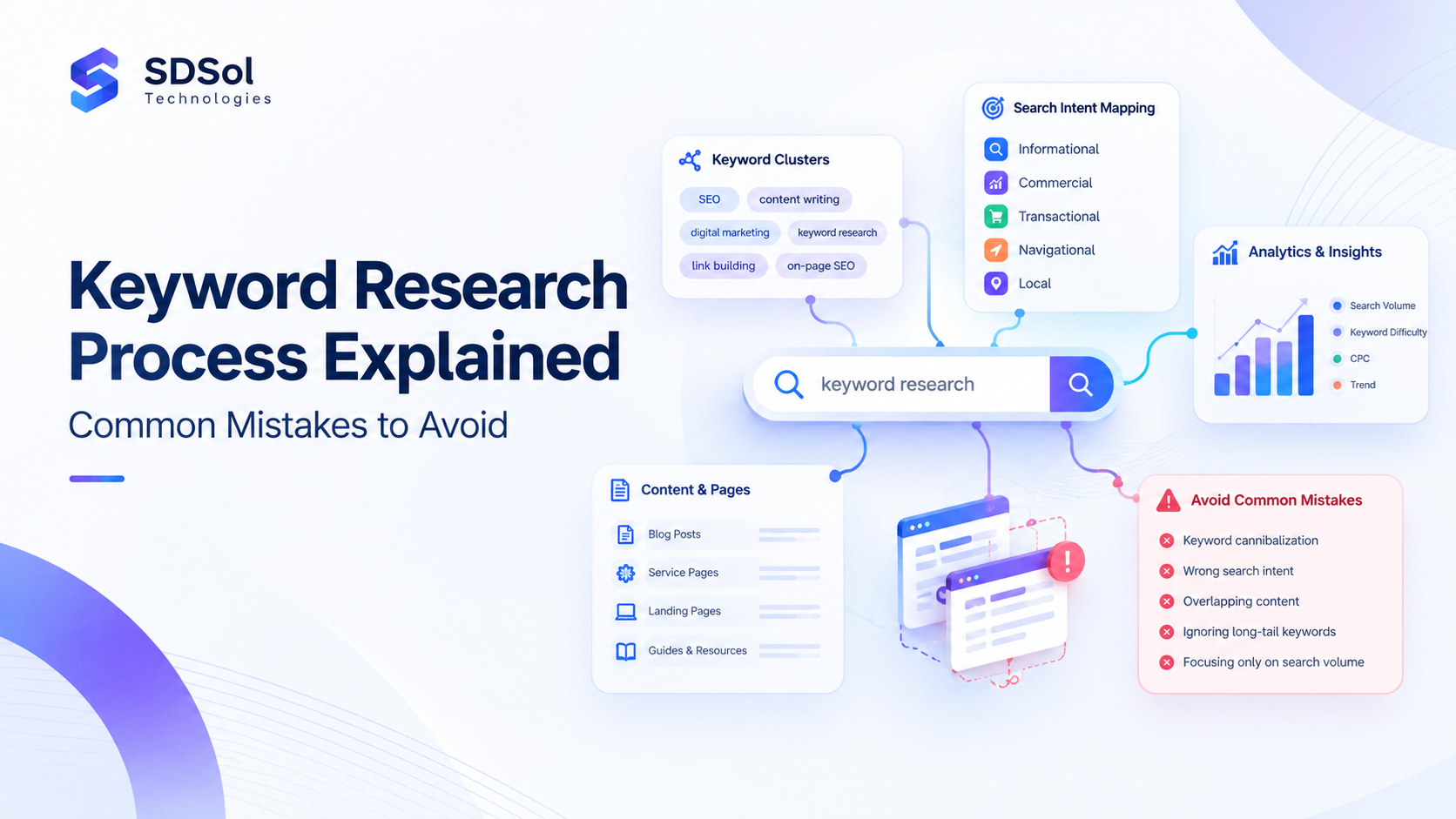
Keyword research is often treated as a simple task: open an SEO tool, enter a topic, export a list, and choose keywords with the highest search volume.
That approach misses the most important part.
The real keyword research process is about understanding what people search for, why they search for it, how competitive those searches are, what type of content Google expects, and whether attracting those visitors can actually help your business.
Google itself recommends thinking about the words users might search for while also emphasizing helpful, reliable, people-first content. Its language systems can understand relationships between related terms, so successful SEO does not require mechanically repeating an exact phrase.
In this guide, you will learn a practical keyword research process from beginning to end, including keyword discovery, search intent analysis, competition evaluation, keyword clustering, prioritization, mapping, implementation, and measurement.
You will also learn the common mistakes that cause businesses to target the wrong keywords—even when the keyword data looks attractive.
What Is Keyword Research?
Keyword research is the process of discovering and evaluating the search terms people use when looking for information, products, services, or solutions online.
A keyword can be a single word such as “shoes,” a phrase such as “running shoes,” or a longer query such as “best running shoes for beginners.”
However, modern SEO is broader than matching one phrase to one page. Google says its language systems can understand how a page relates to different searches, even when the exact wording is not repeated.
That means good research should identify:
- What the audience wants
- What problem they are trying to solve
- What language they use
- What content format satisfies them
- How competitive the SERP is
- Whether the topic has business value
- Which page should target the query
A useful way to think about the process is:
Audience → Search terms → Intent → Competition → Business value → Content → Measurement
That sequence is much more useful than simply collecting a large spreadsheet of keywords.
Why Is Keyword Research Important for SEO?
Keyword research helps connect your website with the language and needs of your target audience.
If you understand the searches people make, you can build pages around subjects that are relevant to them instead of publishing content based only on assumptions.
It can help you:
- Discover new content opportunities
- Understand audience problems
- Identify relevant topics
- Match pages with search intent
- Prioritize SEO opportunities
- Improve content planning
- Find gaps in competitor coverage
- Identify commercial opportunities
- Build topic clusters
- Measure whether your content attracts relevant searches
Google Search Console is particularly useful after publication because its Performance report shows queries, clicks, impressions, CTR, and average position. This allows you to discover the searches that actually bring visibility to your site.
The Keyword Research Process: 9 Practical Steps
A reliable workflow can be divided into nine stages:
- Define the business goal and audience.
- Create seed keywords.
- Expand keyword ideas.
- Analyze search intent.
- Evaluate competition and difficulty.
- Assess business value.
- Group related keywords.
- Map keywords to pages.
- Publish, measure, and refine.
Each stage solves a different problem.
Skipping one may produce a keyword list, but not necessarily a useful SEO strategy.
Step 1: Define Your Audience and SEO Goal
Before opening a keyword tool, decide what you are trying to accomplish.
For example, a local roofing company might want:
- Emergency service leads
- Roofing inspection requests
- Local visibility
- Service-specific traffic
A software company might instead want:
- Product comparisons
- Educational traffic
- Trial signups
- Problem-based searches
The same keyword metric can mean different things to different businesses.
Ask:
- Who is the ideal visitor?
- What problem do they have?
- What service or product do we provide?
- What action should the visitor take?
- Are we trying to generate traffic, leads, sales, awareness, or authority?
This prevents you from selecting keywords simply because they have impressive numbers.
Step 2: Start With Seed Keywords
A seed keyword is a broad starting term from which you generate more specific keyword ideas.
For an SEO agency, seed keywords could include:
- SEO
- keyword research
- technical SEO
- local SEO
- content marketing
- link building
For a bakery:
- birthday cakes
- wedding cakes
- custom cakes
- cupcakes
- bakery delivery
Do not try to create the perfect keyword list at this stage.
Your goal is to create several starting points that represent your products, services, topics, and customer problems.
Step 3: Expand Your Keyword Ideas
Once you have seed terms, expand them using multiple sources.
Possible sources include:
- SEO keyword research platforms
- Google Search results
- Related searches
- People Also Ask
- Google Search Console
- Keyword Planner
- Competitor pages
- Customer questions
- Sales conversations
- Support tickets
- Reddit and relevant communities
- Internal website search data
Different sources reveal different aspects of demand.
For example, an SEO tool may show estimated search volume, while customer conversations can reveal language that a keyword database does not make obvious.
Current keyword research guidance from Semrush and Ahrefs similarly recommends beginning with known topics or seed keywords, expanding the list, studying competitors, and then filtering and prioritizing opportunities.
Example
Suppose your seed keyword is:
keyword research
Possible related ideas might include:
- keyword research tools
- keyword research for beginners
- keyword research strategy
- keyword research process
- how to do keyword research
- keyword research mistakes
- long-tail keyword research
- competitor keyword research
At this point, you have ideas—not final targets.
The next step is evaluation.
Step 4: Analyze Search Intent
Search intent is the reason behind a search query.
It answers the question:
“What does the searcher actually want when they type this query?”
The four commonly used categories are:
| Intent | What the user wants | Example |
|---|---|---|
| Informational | Learn something | “how does SEO work” |
| Navigational | Find a specific destination | “Google Search Console” |
| Commercial | Compare before deciding | “best SEO tools” |
| Transactional | Complete an action | “buy SEO software” |
Some searches contain mixed intent.
That is why you should not rely only on a tool-generated intent label. Search the keyword yourself and study the results.
For example, if most results for a query are comparison pages, creating a purely educational article may not satisfy the same intent.
Search intent is essentially about matching the content with the expectation behind the query.
A simple SERP test
Search your candidate keyword and ask:
- What type of pages dominate?
- Are they blog posts, product pages, category pages, tools, videos, or local listings?
- Are the results answering a question?
- Are users comparing options?
- Are they trying to purchase something?
- Is the SERP mixed?
If the current results consistently satisfy one intent, your page should normally address that intent too.
Step 5: Evaluate Search Volume Carefully
Search volume estimates how frequently a keyword is searched within a selected period and location.
It can be useful, but it should never be your only selection criterion.
Consider two keywords:
Keyword A: 20,000 searches per month
Keyword B: 700 searches per month
At first glance, Keyword A looks better.
But imagine:
- Keyword A attracts people who are only researching.
- Keyword B attracts people actively looking for your service.
- Keyword A is extremely competitive.
- Keyword B has a realistic opportunity.
- Keyword A has little commercial relevance.
- Keyword B directly solves a problem your company sells a solution for.
Keyword B could be more valuable.
Search volume tells you about potential demand. It does not automatically tell you the value of that demand.
Step 6: Evaluate Keyword Difficulty and Competition
Keyword difficulty is an estimate of how challenging it may be to rank for a query.
Different SEO platforms calculate this metric differently. Ahrefs, for example, uses referring-domain data from top-ranking pages for its KD metric.
Do not interpret a difficulty score as a guarantee.
Instead, investigate the actual SERP.
Look at:
- Quality of ranking pages
- Topical relevance
- Content depth
- Domain strength
- Backlink profiles
- Search intent alignment
- Brand dominance
- Freshness
- SERP features
- Page quality
- Your own website’s competitiveness
A high difficulty score does not automatically mean “never target this keyword.”
It may simply mean that the opportunity requires more resources.
Likewise, a low score does not guarantee an easy ranking.
Ahrefs explicitly notes that difficulty metrics are estimates and recommends examining the ranking pages and broader ranking conditions rather than treating a score as an absolute answer.
Step 7: Consider Business Value
This is one of the most overlooked parts of the keyword research process.
Ask:
“If we ranked for this keyword, would the resulting visitor matter to the business?”
Consider:
- Relevance to your product
- Relevance to your service
- Purchase intent
- Lead potential
- Customer lifetime value
- Brand relevance
- Ability to create a useful page
- Relationship to your conversion funnel
A keyword with 100 searches may be more valuable than a keyword with 10,000 searches if the smaller audience is highly relevant.
Simple prioritization model
You can score each keyword from 1–5 for:
- Relevance
- Intent
- Business value
- Ranking opportunity
- Traffic potential
Then calculate a simple overall score.
This does not need to be mathematically perfect.
The purpose is to force better decisions.
Step 8: Group Keywords Into Clusters
Keyword clustering means grouping closely related searches that can be addressed by the same page or content resource.
For example:
Cluster: keyword research
- keyword research process
- how to do keyword research
- keyword research steps
- keyword research guide
These may represent one strong topic rather than four completely separate articles.
However, do not automatically combine every similar-looking phrase.
The SERP can tell you whether Google treats two queries as substantially similar.
If two keywords consistently return very different page types or search intents, they may deserve separate pages.
Modern keyword research workflows commonly use parent topics, intent, and SERP similarity to organize terms into useful groups.
Step 9: Map Keywords to the Right Pages
Keyword mapping means assigning target keywords and topic clusters to specific URLs.
For example:
| Keyword Cluster | Recommended Page |
|---|---|
| keyword research | Comprehensive guide |
| keyword research tools | Tool comparison page |
| local keyword research | Local SEO guide |
| keyword research services | Service page |
| keyword research mistakes | Educational blog post |
This prevents random publishing.
It also reduces the risk of multiple pages competing for the same topic.
A useful rule is:
One primary search intent → one strongest destination page.
You can still naturally cover multiple related queries on that page.
How Many Keywords Should One Page Target?
There is no universal number.
A page should target a primary topic and naturally cover related queries that belong to the same intent.
For example, a page about “keyword research process” can naturally discuss:
- keyword research steps
- keyword selection
- search intent
- keyword difficulty
- keyword clustering
- keyword mapping
There is no need to create a separate page for every variation.
Google’s current SEO guidance emphasizes understanding how users search and notes that its language systems can understand related queries without requiring exact-match repetition.
Common Keyword Research Mistakes to Avoid
Even a large keyword database can produce a weak SEO strategy if the analysis is poor.
Mistake 1: Choosing Keywords Only Because They Have High Volume
High volume looks attractive, but traffic is not the same as business value.
Better approach: Combine volume with intent, competition, relevance, and business potential.
Mistake 2: Ignoring Search Intent
A keyword can look perfect in a spreadsheet and still be wrong for your page.
Better approach: Search the query and study the current SERP before deciding what to create.
Mistake 3: Treating Keyword Difficulty as an Absolute Truth
A KD score is an estimate, not a ranking guarantee.
Better approach: Inspect the actual competitors and evaluate your ability to produce a better result.
Mistake 4: Targeting Only Short Keywords
Short keywords are often broad and competitive.
For example:
“SEO”
is much broader than:
“SEO keyword research process for small business websites.”
Long-tail searches can reveal more specific needs.
Mistake 5: Ignoring Business Intent
Some keywords generate traffic without generating meaningful business opportunities.
Better approach: Ask what happens after the visitor arrives.
Mistake 6: Creating One Article for Every Keyword Variation
This can create unnecessary pages with overlapping topics.
Better approach: Cluster related terms and determine whether they share search intent.
Mistake 7: Copying Competitors’ Keywords
Competitor analysis is useful, but copying their keyword list is not a strategy.
Your business may have different:
- Products
- Customers
- Expertise
- Geographic markets
- Conversion goals
- Content strengths
Use competitor research to discover opportunities, not duplicate another website.
Mistake 8: Forgetting Existing Rankings
Your website may already rank for valuable searches you have never deliberately targeted.
Google Search Console can reveal queries generating impressions and clicks for your pages.
These existing queries can become valuable optimization opportunities.
Mistake 9: Stuffing Exact-Match Keywords
Repeating the same phrase unnaturally can make content difficult to read.
Use:
- Natural variations
- Synonyms
- Related concepts
- Questions
- Examples
- Contextual terminology
The goal is to explain the topic completely, not to repeat a phrase mechanically.
Mistake 10: Never Updating Your Research
Search behavior, competition, products, and business priorities change.
Your keyword strategy should therefore be treated as an ongoing process rather than a one-time spreadsheet.
A Practical Keyword Research Example
Imagine an agency offers SEO services.
The initial seed keyword is:
SEO services
The research expands into:
- SEO services for small business
- local SEO services
- technical SEO services
- SEO audit services
- affordable SEO services
- enterprise SEO services
- SEO consultant
- SEO agency
- SEO packages
Now classify the terms.
Informational:
- what is SEO
- how SEO works
- SEO checklist
Commercial:
- best SEO agency
- SEO services for small business
- affordable SEO services
Transactional:
- hire SEO consultant
- SEO audit services
- SEO services
Then evaluate:
- Relevance
- Intent
- Search volume
- Competition
- Business value
- Current SERP
- Existing website authority
Finally, map each cluster to an appropriate page.
This is much more strategic than publishing one article simply because “SEO services” has a large search volume.
How to Use Google Search Console in the Process
Keyword research should not stop when the article is published.
Search Console provides real-world data about how your website appears in Google Search.
The Performance report includes metrics such as:
- Clicks
- Impressions
- CTR
- Average position
- Queries
- Pages
- Countries
- Devices
After publishing a page, review its query data periodically.
Look for:
High impressions + low CTR
The page may need a stronger title or better search-result presentation.
Impressions + positions around page one
The content may have an opportunity for further optimization.
Unexpected relevant queries
These can reveal subtopics that deserve stronger coverage.
Queries unrelated to the page
These may indicate content ambiguity or an opportunity to improve topical focus.
This creates a feedback loop:
Research → Publish → Measure → Learn → Improve
Keyword Research for AEO and AI Search
Modern search increasingly includes AI-generated experiences, but this does not mean you should abandon traditional SEO.
Google’s current guidance says its generative AI search features use its core Search systems and that existing SEO best practices remain relevant. Google also says there are no additional special technical requirements or special schema needed specifically to appear in AI Overviews or AI Mode.
For content intended to be useful in answer-driven search, focus on:
- Clear definitions
- Direct answers
- Question-based headings
- Complete explanations
- Relevant entities
- Logical relationships between concepts
- Structured lists
- Original useful information
- Accurate claims
- Helpful examples
Instead of trying to create artificial “AI keywords,” build content that clearly answers the underlying questions.
For example, a page targeting “keyword research process” should naturally answer:
- What is keyword research?
- Why does it matter?
- How do you do it?
- Which metrics matter?
- How do you evaluate intent?
- How do you prioritize keywords?
- What mistakes should you avoid?
That creates a much stronger information resource.
How to Build a Keyword Research Checklist
Before finalizing your keyword list, ask:
Business relevance
- Does the keyword relate to our offering?
- Could the visitor become a customer?
- Does the topic support our business goals?
Search intent
- Do we understand what the searcher wants?
- Does our planned page format match the SERP?
- Is the intent informational, commercial, transactional, navigational, local, or mixed?
Competition
- Who currently ranks?
- Are the results highly authoritative?
- Can we create something meaningfully better?
- Is the opportunity realistic for our website?
Content
- Can we provide a genuinely useful answer?
- What subtopics should the page cover?
- Are there related questions worth answering?
Strategy
- Does this keyword belong to an existing cluster?
- Should it have its own page?
- Could it cause keyword cannibalization?
- Where does it fit in the content funnel?
Measurement
- How will success be measured?
- Will we track impressions?
- Clicks?
- CTR?
- Rankings?
- Leads?
- Sales?
Advanced Keyword Research: Go Beyond Search Volume
Once you understand the basics, introduce additional signals.
Traffic potential
A keyword may have several related queries that collectively create a larger traffic opportunity.
SERP features
Look for:
- Featured snippets
- Images
- Videos
- Local results
- Shopping results
- Discussions
- AI features
The SERP itself provides clues about how Google interprets the query.
Content format
Determine whether users expect:
- Guide
- Tutorial
- Comparison
- Product page
- Service page
- Category page
- Calculator
- Tool
- List
- Video
Topical authority
A website with strong coverage around a subject can create a more useful content ecosystem than isolated pages targeting unrelated terms.
Business potential
Ask whether the keyword supports a meaningful commercial pathway.
This is especially important for businesses that care more about qualified leads than raw traffic.
What Makes a Good Keyword?
A good keyword is not necessarily the keyword with the highest search volume.
A strong target generally has a combination of:
Relevance + Intent Match + Business Value + Ranking Opportunity + Useful Content Potential
The ideal balance depends on the website.
For a new website, lower-competition long-tail opportunities may be more practical.
For an established site, broader competitive topics may be worth pursuing as part of a long-term strategy.
There is no universal keyword score that can make the decision for you.
How Often Should You Do Keyword Research?
There is no single schedule that works for every business.
A practical approach is:
- Conduct foundational research before building a content strategy.
- Review performance after publishing.
- Reassess important topics periodically.
- Refresh research when products, services, markets, or competitors change.
- Use Search Console data to discover new opportunities.
For established websites, keyword research becomes a continuous learning system rather than a one-time task.
Final Takeaway
The most effective keyword research process is not about collecting the biggest possible list of search terms.
It is about making better decisions.
Start with your audience and business goals. Generate seed keywords. Expand your ideas. Analyze search intent. Study the SERP. Evaluate competition and business value. Group related terms. Map them to the correct pages. Then use actual performance data to improve your strategy.
Most importantly, do not let a single metric—especially search volume or keyword difficulty—make the decision for you.
A keyword becomes valuable when it represents a real audience need, matches the purpose of your page, offers a realistic opportunity, and supports a meaningful business goal.
If your current keyword strategy is based mainly on spreadsheets and search-volume numbers, the next step is simple: revisit your most important topics and evaluate them using intent, relevance, competition, business value, and SERP evidence.
That is how keyword research becomes a practical SEO strategy rather than just a list of words.