
Subtotal ₨ 0
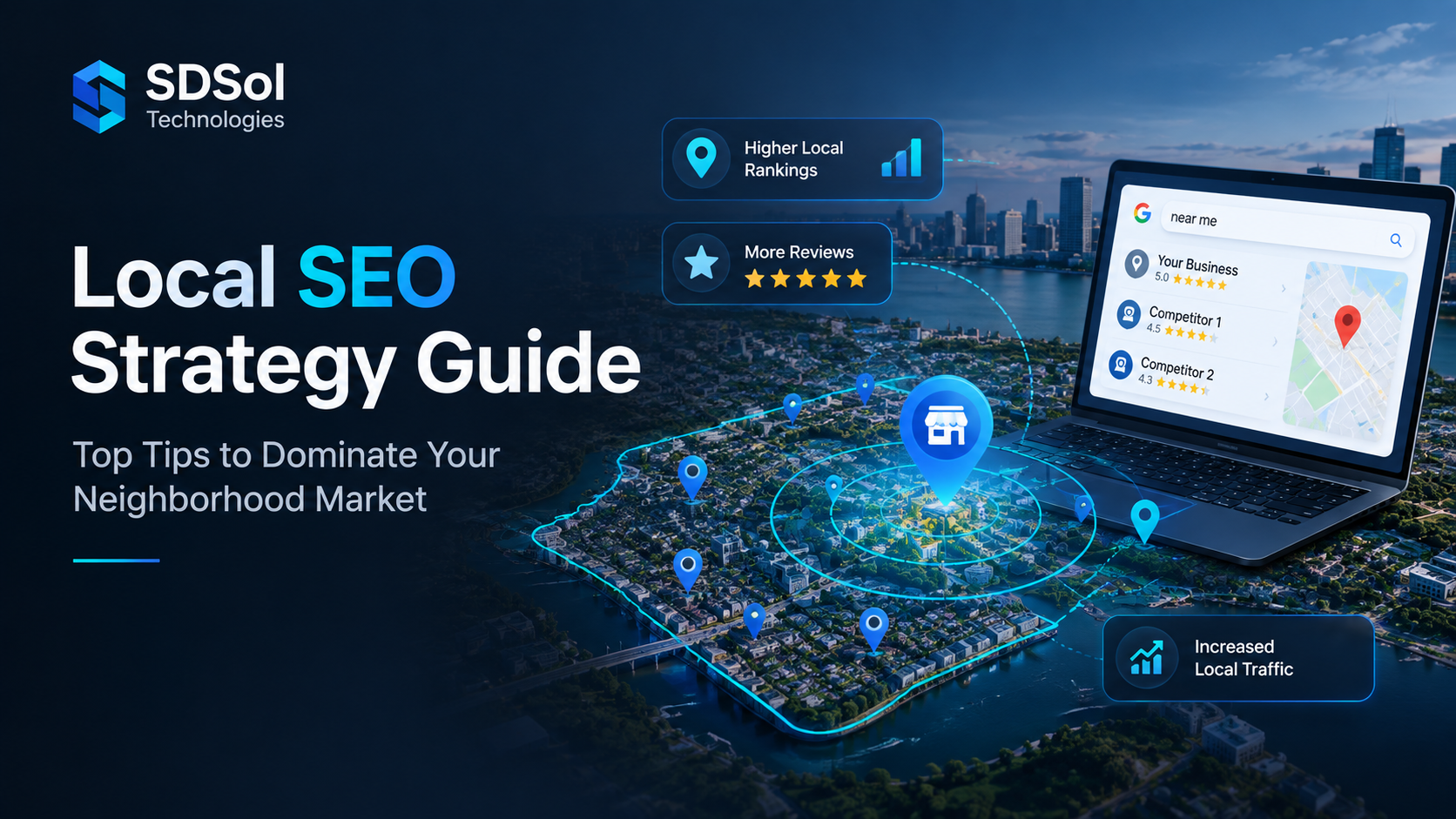
If customers can find your competitors on Google but struggle to find your business, the problem may not be your products or services. Your local search visibility may simply be underdeveloped.
A strong local SEO strategy guide should do more than tell you to create a Google Business Profile or add your city to your homepage. Local visibility depends on how clearly Google can understand your business, where you operate, what you offer, and how relevant and prominent your business appears for a particular search.
Google says local results are primarily influenced by relevance, distance, and prominence. Complete and accurate Business Profile information can help Google understand a business, while reviews and links are among the information Google considers when assessing prominence.
That means effective local SEO is not one task. It is a system.
This local SEO strategy guide explains that system step by step. You will learn how to optimize your Google Business Profile, build location relevance, create useful local content, manage reviews and citations, earn local links, use structured data correctly, measure results, and turn local search visibility into real customer actions.
Whether you run a dental clinic, restaurant, law firm, retail store, real estate company, agency, or home-service business, the same fundamental principles apply—with adjustments based on your business model and service area.
This local SEO strategy guide explains how businesses can improve their visibility in local search results.
What Is Local SEO?
Local SEO is the process of improving a business’s visibility when people search for products, services, or businesses associated with a particular geographic area.
For example, someone might search:
- dentist near me
- emergency plumber in Lahore
- Italian restaurant downtown
- family lawyer in Manchester
- roofing company near Austin
- real estate agent in Dubai
Local SEO helps search engines connect these searches with relevant businesses and locations.
It is important to understand that local SEO is not simply “adding location keywords.” A business needs accurate business information, a useful website, appropriate local signals, genuine customer feedback, and a clear connection between its services and the geographic areas it serves.
Google also gathers local business information from multiple sources, including publicly available web content, third-party data, users, and information supplied through Business Profiles.
That is why consistency matters across your website and other business listings.
A well-planned local SEO strategy guide can help small businesses attract customers searching for nearby products and services.
Why Is Local SEO Important for Small Businesses?
A small business does not necessarily need to compete nationally to generate significant search traffic.
A local bakery may only need customers within a few miles. A dentist may primarily serve nearby neighborhoods. A plumber may have a defined service radius. A law firm may focus on particular cities or counties.
A well-planned local SEO strategy guide can help small businesses attract customers searching for nearby products and services.
This makes local SEO especially valuable because it connects visibility with geographic relevance.
Consider two businesses:
Business A has a beautiful website but incomplete business information, few reviews, weak local content, and no clear service-area strategy.
Business B has a technically sound website, an accurate Business Profile, useful service pages, authentic reviews, strong local relevance, and references from reputable local websites.
Business B has created more signals that help both users and search systems understand its local offering.
A good local SEO strategy guide therefore has to consider the complete customer journey—not only rankings.
The real objective is:
Search → visibility → trust → website visit/call/directions → customer → review/referral
Ranking is useful, but business outcomes matter more.
How Does Local SEO Work?
Local SEO works by helping search systems determine which businesses are relevant to a user’s local need.
Google identifies local results using factors including:
- Relevance — How closely the business matches what the person searched for.
- Distance — How close the business is to the searcher or relevant location.
- Prominence — How well-known or established the business appears to be.
These are not independent switches. A business can be highly relevant but too far away for a particular search. Another may be nearby but poorly matched to the service requested. Google does not provide a formula that businesses can use to calculate their exact local ranking.
This is why a sensible local SEO strategy guide should focus on improving the overall quality and relevance of the business’s online presence rather than chasing one supposed ranking trick.
This local SEO strategy guide covers important areas such as Google Business Profile optimization, local keywords, reviews, citations, and backlinks.
Step 1: Optimize Your Google Business Profile
Your Google Business Profile is one of the most important assets in a local SEO campaign.
Start by claiming and verifying the profile and then make sure the information accurately represents the real-world business.
Google recommends keeping business information complete and accurate, including details such as address, hours, business category, and relevant attributes.
Check these profile elements
- Correct business name
- Accurate primary category
- Relevant secondary categories where appropriate
- Correct address
- Accurate service area where applicable
- Current phone number
- Website URL
- Opening hours
- Special holiday hours
- Business description
- Relevant services
- Products where applicable
- High-quality business photos
- Videos where useful
- Appropriate attributes
Do not add keywords to the business name simply because you believe they will improve rankings.
Google’s business representation guidelines say businesses should represent themselves accurately and consistently as they are recognized in the real world.
That is an important E-E-A-T principle too: accuracy builds trust.
Businesses can use this local SEO strategy guide to create a stronger presence in Google Search and Google Maps.
Step 2: Choose the Right Business Categories
Categories help communicate what your business actually does.
Your primary category should represent the main business activity. Additional categories can describe legitimate secondary offerings when they accurately apply.
For example, a dental practice should not choose unrelated categories merely because those terms have search volume.
The goal is not to select the maximum number of categories.
The goal is to select the most accurate categories.
When implementing a local SEO strategy guide, treat categories as a relevance signal rather than a keyword-stuffing opportunity.
Businesses can use this local SEO strategy guide to create a stronger presence in Google Search and Google Maps.
Step 3: Build a Strong Local Keyword Strategy
Local keyword research should begin with customer intent.
Instead of asking only:
“What keywords have the highest search volume?”
Ask:
“What would someone type when they need this service in my area?”
For a roofing company, the keyword universe could include:
- roof repair
- emergency roof repair
- roof replacement
- roofing contractor
- commercial roofing
Then add geographic context where appropriate:
- roof repair in Dallas
- roofing contractor in Plano
- emergency roof repair near me
Do not create hundreds of nearly identical pages just by replacing the city name.
Instead, identify genuine differences between locations, services, customer needs, regulations, neighborhoods, projects, or service availability.
A practical local SEO strategy guide should begin with accurate business information and a clear understanding of the target audience.
Build keyword clusters
A useful structure might be:
Core service
“roof repair”
Service + location
“roof repair in Dallas”
Problem + location
“storm damage roof repair Dallas”
Commercial intent
“best roof repair company Dallas”
Conversational query
“Who can repair a leaking roof near me?”
This approach makes your content more useful because it reflects different stages of the search journey.
A practical local SEO strategy guide should begin with accurate business information and a clear understanding of the target audience.
Step 4: Create Location-Relevant Website Pages
Your website should make it obvious where you operate and what you provide.
At minimum, important local businesses should usually have strong:
- Homepage
- Service pages
- Contact page
- About page
- Location pages where genuinely useful
- Supporting local content
A location page should provide real value.
For example, a genuine location page might explain:
- Services available in the area
- Local service coverage
- Relevant customer needs
- Nearby service areas
- Business address or service-area information
- Contact options
- Unique local information
- Frequently asked questions
- Relevant testimonials when genuine
Avoid producing dozens of thin pages such as:
“Best Dentist in City A”
“Best Dentist in City B”
“Best Dentist in City C”
when the content is otherwise identical.
A better local SEO strategy guide should emphasize meaningful local usefulness rather than mass-produced city pages.
A detailed local SEO strategy guide can help service-area businesses improve their online presence in the communities they serve.
Step 5: Improve NAP Consistency
NAP stands for:
Name + Address + Phone number
The basic principle is straightforward: important business information should be accurate and consistent across legitimate business listings and your website.
For example, if your website lists:
ABC Plumbing Ltd.
123 Main Street
555-123-4567
but several important directories show a different phone number or outdated address, customers may become confused and search engines may have conflicting information.
Create a master business-information document containing:
- Official business name
- Address
- Phone
- Website
- Opening hours
- Main category
- Service areas
- Business description
- Social profiles
Use it as your reference when updating listings.
However, do not obsess over forcing every minor formatting difference into identical text. Accuracy and legitimacy matter more than superficial formatting perfection.
A detailed local SEO strategy guide can help service-area businesses improve their online presence in the communities they serve.
Step 6: Build and Clean Local Citations
A citation is a mention of business information on another website or directory.
Examples can include:
- Local business directories
- Industry directories
- Chamber of commerce websites
- Professional associations
- Local publications
- Relevant community organizations
- Trusted industry platforms
The objective is not to submit your business to hundreds of low-quality directories.
Instead, prioritize relevant, legitimate, and trustworthy sources.
A good citation strategy asks:
- Is the website reputable?
- Is it relevant to my industry?
- Is it relevant to my location?
- Is the listing useful to customers?
- Is the information accurate?
- Does the directory have editorial or quality standards?
This is another area where a quality-first local SEO strategy guide is more useful than an “automate everything” approach.
A detailed local SEO strategy guide can help service-area businesses improve their online presence in the communities they serve.
Step 7: Earn Genuine Customer Reviews
Reviews are valuable because they influence both reputation and customer decision-making.
Google explicitly recommends responding to reviews, noting that replies can show customers that the business values feedback. Google also identifies reviews as information that can contribute to local prominence.
The best review strategy is operational, not manipulative.
After providing a good service:
- Ask the customer for honest feedback.
- Provide a convenient way to leave a review.
- Thank customers who leave feedback.
- Respond professionally.
- Address legitimate complaints.
- Look for recurring issues in negative feedback.
- Never manufacture reviews.
Do not pressure customers to write a specific type of review.
Do not create fake customer accounts.
Do not buy fake ratings.
Trust is more valuable than a temporarily inflated rating.
Responding to negative reviews
A professional response should:
- Stay calm
- Avoid arguing
- Acknowledge the concern
- Avoid revealing private customer information
- Explain how the customer can contact the business
- Focus on resolving the issue
A thoughtful response can demonstrate professionalism even when the original review is negative.
A detailed local SEO strategy guide can help service-area businesses improve their online presence in the communities they serve.
Step 8: Create Content Around Local Search Intent
Local content should answer questions that matter to people in the areas you serve.
Suppose you operate a physiotherapy clinic.
Instead of publishing only generic posts such as “What Is Physiotherapy?”, create useful content around real local needs:
- When should you see a physiotherapist after a sports injury?
- What should you know before your first physiotherapy appointment?
- How can office workers manage recurring back pain?
- What services does the clinic provide?
- Which neighborhoods does the clinic serve?
The content should remain useful even if the reader removes the city name from the query.
This is an important distinction in any local SEO strategy guide: localization should improve usefulness, not merely increase keyword repetition.
The recommendations in this local SEO strategy guide can be adapted for restaurants, dentists, law firms, retailers, agencies, and home-service businesses.
Step 9: Strengthen Internal Linking
Internal links connect related pages on your own website.
For example:
Blog article → service page → location page → contact page
Suppose you have an article about emergency plumbing.
You could naturally link to:
- Emergency plumbing service
- Plumbing services
- Service-area page
- Contact page
Use descriptive anchor text that tells users what they will find.
Do not turn every internal link into an exact-match keyword.
Internal linking can help users discover relevant information and can help search engines understand relationships among your pages.
The recommendations in this local SEO strategy guide can be adapted for restaurants, dentists, law firms, retailers, agencies, and home-service businesses.
Step 10: Earn Local Backlinks
Backlinks are links from other websites to your site.
For local businesses, relevant links can come from:
- Local news websites
- Community organizations
- Chambers of commerce
- Industry associations
- Local event websites
- Sponsorship pages
- Business partnerships
- Local publications
- Relevant suppliers
The strongest opportunities are usually based on genuine relationships or useful contributions.
For example, a local bakery might sponsor a community event and receive a legitimate mention from the event organization.
A law firm might contribute expert commentary to a local publication.
A restaurant might participate in a neighborhood food event.
The objective is not to buy hundreds of irrelevant links.
A strong local SEO strategy guide should emphasize relevance, editorial value, and genuine local connections.
The recommendations in this local SEO strategy guide can be adapted for restaurants, dentists, law firms, retailers, agencies, and home-service businesses.
Step 11: Use Local Business Structured Data Correctly
Structured data gives search engines machine-readable information about your business.
Google’s documentation supports LocalBusiness structured data and recommends using the most specific applicable LocalBusiness subtype. Depending on the business, relevant information can include name, address, telephone number, URL, opening hours, geographic coordinates, and other supported properties.
For example, a restaurant could use an appropriate restaurant subtype rather than a generic business type.
However, structured data is not a magic ranking shortcut.
It should accurately describe information already present on the page.
Google recommends validating structured data and checking how Google sees the page using appropriate testing and inspection tools.
Important review-schema warning
Do not assume that adding review or rating markup automatically creates star results for your own local business.
Google’s review-snippet guidelines contain specific restrictions for local businesses, including circumstances where a business controls the reviews about itself.
Therefore, implement schema based on Google’s current eligibility requirements—not on outdated SEO tutorials.
A modern local SEO strategy guide should include technical SEO, mobile optimization, and structured data.
Step 12: Improve Technical SEO
Local businesses still need a technically healthy website.
Check:
- HTTPS
- Mobile usability
- Page speed
- Core Web Vitals
- Crawlability
- Indexability
- XML sitemap
- Canonical URLs
- Broken links
- Redirects
- Duplicate content
- Image optimization
- JavaScript rendering
- Internal linking
- Clear URL structure
Technical SEO does not replace local relevance.
Instead, it gives search engines and users a stronger technical foundation.
A local business with excellent content but pages that cannot be properly crawled or indexed has an obvious problem.
A modern local SEO strategy guide should include technical SEO, mobile optimization, and structured data.
Step 13: Optimize for Mobile and Conversion
Many local searches happen when people are actively deciding what to do next.
A potential customer may search for a restaurant while traveling, a plumber during an emergency, or a clinic while looking for an appointment.
Your website should make the next action obvious.
Depending on the business, that might be:
- Call now
- Book appointment
- Request quote
- Get directions
- Schedule consultation
- Order online
- Send message
- View services
A good local SEO strategy guide should therefore include conversion optimization.
Do not make visitors search through five pages to find your phone number.
Put important contact information where it is easy to find.
A modern local SEO strategy guide should include technical SEO, mobile optimization, and structured data.
Step 14: Build Location-Specific Trust Signals
Local customers want to know whether a business is legitimate and suitable for their needs.
Strengthen trust with:
- Real business information
- Clear contact details
- Staff or team information
- Professional credentials where applicable
- Genuine testimonials
- Original photographs
- Clear service descriptions
- Policies
- Secure website
- Accurate opening hours
- Transparent pricing where appropriate
- Links to legitimate professional associations
Google’s own guidance emphasizes accurate representation of businesses and service areas.
Do not create fake office addresses simply to appear in additional locations.
If you are a service-area business, represent the business according to the rules that apply to that model.
This local SEO strategy guide shows why businesses should measure calls, leads, bookings, and other meaningful conversions instead of focusing only on rankings.
Step 15: Measure the Right Local SEO Metrics
Traffic alone does not tell you whether local SEO is working.
Track metrics that connect visibility with business outcomes.
Visibility metrics
- Local organic impressions
- Local organic clicks
- Search queries
- Map/profile visibility where available
- Ranking trends for important queries
Engagement metrics
- Website visits
- Calls
- Direction requests
- Appointment actions
- Contact-form submissions
- Online bookings
Reputation metrics
- Review volume
- Review quality
- Review response rate
- Recurring customer feedback themes
Business metrics
- Qualified leads
- Bookings
- Sales
- Cost per lead
- Customer acquisition cost
For example, ranking fifth for a high-intent local service query may be more valuable than ranking first for a low-value informational phrase.
This local SEO strategy guide shows why businesses should measure calls, leads, bookings, and other meaningful conversions instead of focusing only on rankings.
Always connect SEO data to business objectives.
A Practical 30-Day Local SEO Action Plan
If you are starting from scratch, do not attempt everything simultaneously.
Week 1: Foundation
Audit:
- Google Business Profile
- Business information
- Website
- Contact details
- Service pages
- Location information
- Indexing
- Mobile experience
- Reviews
Correct the most important inaccuracies first.
Week 2: Website and Content
Improve:
- Homepage
- Core service pages
- Location pages
- Title tags
- Meta descriptions
- Internal links
- Local keyword targeting
- Conversion elements
Create a content calendar based on local customer questions.
Week 3: Reputation and Citations
Audit important business listings.
Then:
- Correct inaccurate citations
- Build high-value relevant listings
- Develop a review-request process
- Respond to existing reviews
- Identify local partnership opportunities
Week 4: Authority and Measurement
Start:
- Local outreach
- Community partnerships
- Relevant link acquisition
- Local content promotion
- Performance reporting
Document what changed and establish a baseline for future comparison.
This staged approach makes a local SEO strategy guide practical instead of overwhelming.
This local SEO strategy guide shows why businesses should measure calls, leads, bookings, and other meaningful conversions instead of focusing only on rankings.
Common Local SEO Mistakes to Avoid
1. Keyword stuffing the business name
Adding phrases to your real-world business name simply for SEO can create accuracy and policy problems.
2. Creating fake locations
Do not invent addresses where your business does not legitimately operate.
3. Publishing duplicate city pages
Changing only the city name on nearly identical pages provides little additional value.
4. Buying fake reviews
Fake reviews damage trust and can violate platform policies.
5. Ignoring negative reviews
Silence can make legitimate complaints worse.
6. Building low-quality directory links
More listings do not automatically mean better local SEO.
7. Ignoring the website
A Business Profile cannot compensate for a poor website experience.
8. Tracking rankings only
Rankings matter, but calls, leads, bookings, sales, and customer quality matter more.
9. Making unsupported SEO promises
No legitimate local SEO strategy guide should promise a guaranteed number-one position.
Google explicitly states that there is no way to request or pay for a better local ranking.
10. Using outdated schema tactics
Search-result features and structured-data eligibility can change. Always verify current Google documentation before implementing advanced markup.
Using a reliable local SEO strategy guide can help businesses build a consistent and trustworthy online presence.
How Much Does Local SEO Cost?
There is no universal local SEO price.
Costs depend on:
- Number of locations
- Industry competitiveness
- Geographic market
- Website condition
- Existing authority
- Content requirements
- Citation cleanup
- Reputation management
- Link acquisition
- Technical SEO requirements
- Whether the work is performed internally or by an agency
A small single-location business may need a relatively focused campaign.
A multi-location company may require location-specific content, technical architecture, reputation management, centralized reporting, and ongoing local authority development.
The right question is not:
“How cheap can I make local SEO?”
It is:
“What level of investment is justified by the value of acquiring and retaining local customers?”
An advanced local SEO strategy guide should combine traditional SEO with local search intent, AEO, GEO, and conversion optimization.
How Long Does Local SEO Take?
Local SEO does not have a guaranteed timeline.
Some improvements can become visible relatively quickly, particularly when correcting inaccurate or incomplete business information.
Other improvements—such as building authority, earning links, developing content, and generating a strong reputation—can take considerably longer.
Competition also matters.
A business entering a low-competition local market may have a different experience from one competing against established businesses with strong websites, reviews, links, and brand recognition.
Treat local SEO as an ongoing process rather than a one-time submission.
An advanced local SEO strategy guide should combine traditional SEO with local search intent, AEO, GEO, and conversion optimization.
Is Local SEO Worth It?
For businesses that depend on customers from specific geographic areas, local SEO can be highly valuable because it targets people with location-related intent.
However, the value depends on:
- Search demand
- Customer lifetime value
- Competition
- Service area
- Conversion rate
- Business quality
- Reputation
- Ability to serve the resulting demand
If a business consistently receives qualified customers through local search, improving that channel can be commercially meaningful.
The goal should be sustainable visibility and profitable customer acquisition—not vanity metrics.
An advanced local SEO strategy guide should combine traditional SEO with local search intent, AEO, GEO, and conversion optimization.
An Advanced Local SEO Strategy
Once the fundamentals are working, move toward a more sophisticated system.
Segment search intent
Separate:
- Discovery searches
- Comparison searches
- Service searches
- Emergency searches
- Brand searches
- “Near me” searches
- Informational searches
Create content and landing experiences for the intent that actually matters.
Build topical authority
A local service business can develop supporting content around:
- Services
- Problems
- Costs
- Maintenance
- Safety
- Comparisons
- FAQs
- Local regulations where relevant
- Customer preparation
- Industry developments
This creates a stronger information ecosystem than publishing disconnected blog posts.
Connect local SEO with reputation
Your reviews can reveal the language customers naturally use when describing your services.
Those themes can inform:
- FAQ content
- Service-page copy
- Customer-service improvements
- Content topics
- Conversion messaging
Do not copy reviews artificially into pages. Instead, use genuine customer language as insight into customer needs.
Connect SEO with operations
This is one of the most overlooked parts of local marketing.
If customers repeatedly complain about:
- Slow response times
- Confusing booking
- Inaccurate hours
- Poor communication
- Difficult parking
- Unclear pricing
the SEO team cannot solve the underlying business problem alone.
Better local marketing often begins with a better customer experience.
This local SEO strategy guide can serve as a practical roadmap for businesses that want to improve their local search visibility.
Local SEO for Service-Area Businesses
Not every business has a storefront that customers visit.
Examples include:
- Plumbers
- Electricians
- Roofers
- Cleaners
- Landscapers
- Mobile mechanics
- Pest-control companies
For these businesses, location strategy must reflect the actual service area.
Do not create fake storefront addresses merely to appear closer to searchers.
Instead, clearly communicate the areas you legitimately serve and build useful location-relevant content where there is genuine value.
This makes a local SEO strategy guide particularly important for service businesses because their geographic model differs from that of a physical retail location.
This local SEO strategy guide can serve as a practical roadmap for businesses that want to improve their local search visibility.
What Should You Do First?
If your local SEO is weak, prioritize your work in this order:
- Verify business accuracy
- Optimize the Google Business Profile
- Fix important website and technical problems
- Improve core service pages
- Create genuinely useful location content
- Develop a legitimate review process
- Clean important citations
- Build relevant local relationships and links
- Strengthen internal linking
- Measure leads and conversions
- Improve based on actual customer behavior
This order prevents businesses from spending money on advanced tactics while basic information remains incomplete.
By following the steps in this local SEO strategy guide, businesses can build a stronger foundation for attracting and converting local customers.
Final Local SEO Checklist
Before considering your campaign ready, ask:
Google Business Profile
- Is the profile verified?
- Is the business name accurate?
- Is the primary category appropriate?
- Are hours current?
- Is the address or service area accurate?
- Are photos useful and genuine?
- Are customer reviews being monitored?
- Are reviews being answered professionally?
Website
- Does the homepage clearly explain the business?
- Are services clearly described?
- Are important locations represented accurately?
- Are pages indexable?
- Is the site mobile-friendly?
- Is HTTPS enabled?
- Are important pages internally linked?
- Are contact options easy to find?
Content
- Does content answer real customer questions?
- Is local information genuinely useful?
- Are location pages unique and valuable?
- Are keywords used naturally?
- Are claims supported?
- Is content reviewed and updated when necessary?
Authority
- Are important local citations accurate?
- Does the business have relevant local relationships?
- Are there legitimate backlink opportunities?
- Is the business represented by trustworthy organizations?
Measurement
- Are organic search results monitored?
- Are local visibility trends reviewed?
- Are calls and leads tracked?
- Are bookings measured?
- Is customer acquisition evaluated?
Conclusion: Build Local Visibility Around Trust and Relevance
The strongest local search strategy is not a collection of tricks.
It is a coordinated system that makes your business easier to understand, easier to trust, easier to find, and easier to contact.
Google’s current guidance emphasizes relevance, distance, and prominence for local results. Businesses can improve the quality of their presence by maintaining accurate information, responding to reviews, adding useful visual content, and building a legitimate online presence.
Your website then supports that presence with useful service pages, meaningful location content, strong internal linking, technical accessibility, structured data where appropriate, and clear conversion paths.
The most effective local SEO strategy guide is therefore not about manipulating a ranking system. It is about making the real business more understandable and useful across the places where customers search.
Start with the fundamentals. Fix inaccurate information. Improve your most important pages. Build genuine customer trust. Earn legitimate local mentions. Measure real business outcomes. Then expand the strategy based on what the data and customers tell you.
If you want to improve local visibility, the best next step is to perform a complete local SEO audit covering your Business Profile, website, citations, reviews, content, technical SEO, local authority, and conversion experience.
Ready to turn local search visibility into qualified customers? Start with the highest-impact issues first, then build a sustainable optimization process around them.