
Subtotal ₨ 0
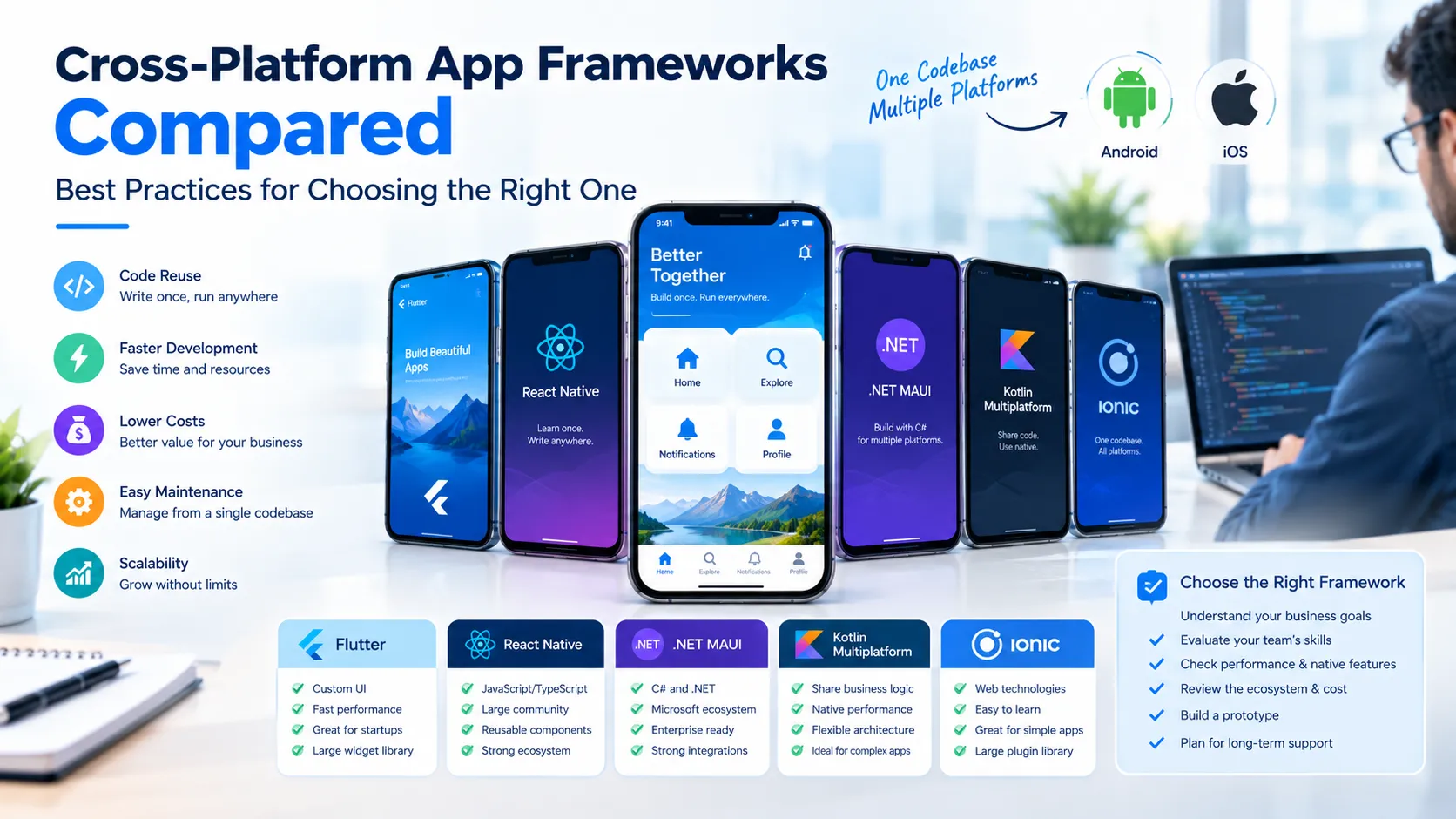
Choosing the right technology is one of the most important decisions in mobile app development. Businesses want applications that work smoothly on multiple devices, provide a great user experience, remain affordable to maintain, and can grow as the business grows.
This is where cross-platform app frameworks have become an important option..
Instead of building completely separate applications for Android and iOS, cross-platform development allows teams to share a significant portion of their code across multiple platforms. This approach can reduce development effort, simplify maintenance, and help businesses launch products more efficiently.
However, not every framework is suitable for every project.
Some applications require advanced native device capabilities. Others prioritize fast development, a consistent user interface, enterprise integration, or a large developer ecosystem. Choosing the wrong framework can create performance problems, maintenance challenges, or unnecessary development costs.
In this guide, we will compare popular cross-platform app frameworks, explain their strengths and limitations, and share practical best practices for choosing the right framework for your business.
What Are Cross-Platform App Frameworks?
Cross-platform app frameworks are development technologies that allow developers to create applications for multiple operating systems using a shared codebase or shared development approach.
Instead of maintaining completely separate Android and iOS projects, developers can reuse a substantial amount of code.
Common cross-platform app frameworks include:
- Flutter
- React Native
- .NET MAUI
- Kotlin Multiplatform
- Ionic
The exact amount of code that can be shared depends on the framework, project architecture, platform requirements, and features being developed.
The main goal is simple:
Build applications for multiple platforms efficiently while maintaining good performance and user experience.
Why Are Cross-Platform App Frameworks Popular?
Businesses often choose cross-platform app frameworks because they can simplify the development process.
Instead of creating separate teams for Android and iOS, a company may be able to share developers, business logic, testing processes, and other resources.
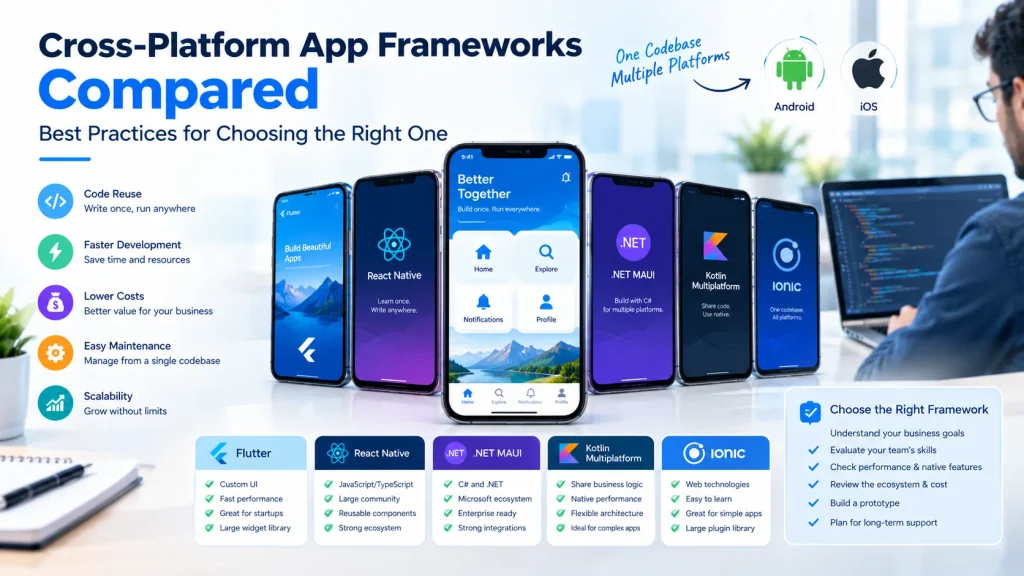
Potential benefits include:
- Faster development
- Code reuse
- Lower development effort
- Easier maintenance
- Consistent application behavior
- Simplified testing
- Faster feature releases
- Broader platform coverage
However, cross-platform development is not automatically the best solution.
The right decision depends on your application’s requirements.Cross-Platform App Frameworks
Cross-Platform App Frameworks Compared
Before looking at best practices, it helps to understand the major options.
| Framework | Main Technology | Best For | Key Strength |
|---|---|---|---|
| Flutter | Dart | Custom UI and startups | Consistent UI |
| React Native | JavaScript/TypeScript | Modern business apps | Large ecosystem |
| .NET MAUI | C#/.NET | Microsoft-focused businesses | .NET integration |
| Kotlin Multiplatform | Kotlin | Shared business logic | Native approach |
| Ionic | Web technologies | Web-focused teams | Web technology reuse |
Each framework has a different philosophy, so choosing between cross-platform app frameworks should begin with your project requirements rather than popularity.
1. Flutter
Flutter is a popular framework developed by Google that uses the Dart programming language.
One of its biggest advantages is its approach to user interface development. Flutter provides a large collection of customizable widgets, allowing developers to create highly consistent interfaces across platforms.
Advantages of Flutter
- Strong UI customization
- Shared codebase
- Good development experience
- Hot reload
- Large ecosystem
- Suitable for visually rich applications
- Useful for rapid prototyping
Flutter can be particularly attractive for startups and businesses that want a highly customized visual experience.
Potential Limitations
Flutter also has considerations that businesses should evaluate.
Teams need developers familiar with Dart, and applications may require platform-specific code when advanced native capabilities are needed.
Businesses should also evaluate the long-term maintenance requirements of the specific Flutter project rather than assuming that every feature can be handled entirely through shared code.
2. React Native
React Native is another widely used option among cross-platform app frameworks.
It uses JavaScript or TypeScript and is based around the React ecosystem.
This can make React Native attractive to organizations that already have web developers working with React.
Advantages of React Native
- JavaScript/TypeScript ecosystem
- Strong developer community
- Reusable components
- Fast development workflow
- Large ecosystem of packages
- Familiar technology for React teams
React Native can be a strong choice for businesses that already have JavaScript or TypeScript expertise.
Potential Limitations
Some projects may still require native Android or iOS development for specialized functionality.
Third-party dependencies should also be evaluated carefully because relying heavily on external packages can increase maintenance complexity.
3. .NET MAUI
.NET MAUI is Microsoft’s cross-platform framework for building applications using .NET and C#.
It can be especially attractive for organizations already invested in the Microsoft ecosystem.
Advantages of .NET MAUI
- C# development
- .NET ecosystem integration
- Microsoft tooling
- Shared code
- Suitable for enterprise environments
- Strong integration possibilities with existing .NET systems
Potential Limitations
The framework may be less attractive for teams without .NET experience.
Businesses should also consider their existing technology stack before choosing among cross-platform app frameworks.
If your organization already uses C#, .NET, Azure, and related Microsoft technologies, .NET MAUI may deserve serious consideration.
4. Kotlin Multiplatform
Kotlin Multiplatform takes a somewhat different approach.
Instead of forcing every part of an application to use the same cross-platform implementation, developers can share selected code while retaining native platform capabilities where appropriate.
This can be useful for businesses that want code sharing while maintaining a strong native development approach.
Advantages of Kotlin Multiplatform
- Kotlin ecosystem
- Native platform integration
- Shared business logic
- Flexible architecture
- Strong option for teams familiar with Kotlin
Potential Limitations
It may require more platform-specific knowledge than some other cross-platform approaches.
Teams should evaluate their Android and iOS expertise before selecting it.
5. Ionic
Ionic uses web technologies such as HTML, CSS, and JavaScript to create applications that can run across platforms.
It can be appealing to businesses that already have strong web development teams.
Advantages of Ionic
- Familiar web technologies
- Easy transition for web developers
- Reusable web development skills
- Suitable for certain business applications
- Efficient for teams with web expertise
Potential Limitations
Applications with demanding graphics, advanced native features, or highly specialized performance requirements may require careful evaluation.
The correct choice among cross-platform app frameworks depends heavily on what the application actually needs to do.
Cross-Platform App Frameworks Comparison Table
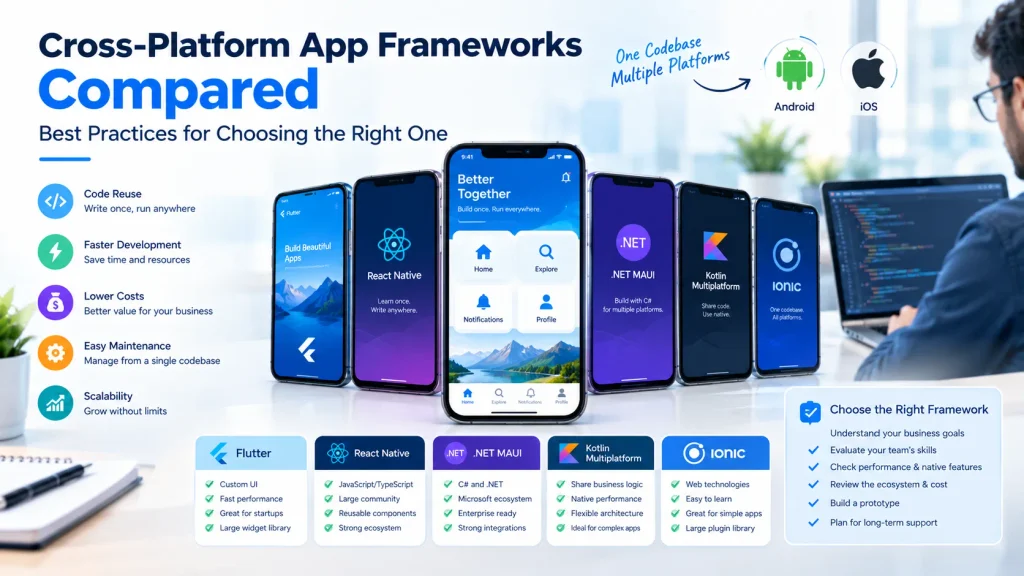
Here is a practical high-level comparison.
| Factor | Flutter | React Native | .NET MAUI | Kotlin Multiplatform | Ionic |
|---|---|---|---|---|---|
| Primary Language | Dart | JavaScript/TypeScript | C# | Kotlin | JavaScript/TypeScript |
| UI Approach | Custom widgets | React-based | Native/platform controls | Native-focused | Web technologies |
| Code Sharing | High | High | High | Selective | High |
| Best For | Custom UI | React teams | .NET businesses | Native-oriented teams | Web teams |
| Learning Curve | Moderate | Moderate | Moderate | Moderate | Lower for web developers |
| Native Integration | Strong | Strong | Strong | Very strong | Depends on implementation |
| Ecosystem | Growing | Large | .NET ecosystem | Kotlin ecosystem | Web ecosystem |
This comparison is only a starting point. Your project requirements should determine the final decision.
Best Practice 1: Start With Business Requirements
The biggest mistake businesses make is choosing a framework before defining the product.
Do not start with:
“Should we use Flutter or React Native?”
Start with:
“What does our application need to accomplish?”
Define:
- Target audience
- Business goals
- Core features
- Target platforms
- Expected number of users
- Performance requirements
- Security requirements
- Third-party integrations
- Budget
- Development timeline
- Long-term maintenance requirements
Once these requirements are clear, comparing cross-platform app frameworks becomes much easier.
Best Practice 2: Consider Your Development Team
Your existing team’s skills should influence your decision.
For example:
- JavaScript/TypeScript team → React Native or Ionic may be attractive.
- C#/.NET team → .NET MAUI may be a natural fit.
- Kotlin team → Kotlin Multiplatform may be worth considering.
- Team prioritizing custom UI → Flutter may be attractive.
Hiring an entirely new team can increase project costs and development time.
A framework that matches your existing technical expertise may therefore provide better long-term value.
Best Practice 3: Analyze Performance Requirements
Performance requirements vary significantly between applications.
A simple business application may not need the same architecture as a graphics-heavy application or a real-time financial product.
Consider:
- Startup speed
- Animation performance
- Memory usage
- Network behavior
- Background processing
- Battery consumption
- Large data sets
- Real-time communication
If your application has demanding performance requirements, conduct technical testing before committing to one of the cross-platform app frameworks.
A prototype can provide more useful information than assumptions based on online comparisons.
Best Practice 4: Consider Native Features
Modern mobile applications may use:
- Camera
- GPS
- Bluetooth
- Biometrics
- NFC
- Push notifications
- Sensors
- Background services
- File systems
- Payments
Before selecting cross-platform app frameworks, make a list of the native features your application needs.
Then check whether the framework provides mature support for them.
If a critical feature requires extensive custom native development, the supposed simplicity of cross-platform development may become less significant.
Best Practice 5: Think About UI Requirements
Some applications need highly customized interfaces.
For example:
- Banking dashboards
- Fitness applications
- Social media platforms
- E-commerce applications
- Creative tools
- Educational applications
Other applications may have relatively simple forms and business workflows.
When comparing cross-platform app frameworks, evaluate how easily each framework can reproduce your desired user experience.
Do not select a framework simply because it can technically display screens.
Ask whether it can deliver the exact interaction quality your customers expect.
Best Practice 6: Evaluate the Ecosystem
A framework is not just its core technology.
You also need libraries, plugins, documentation, developer communities, testing tools, monitoring solutions, and third-party integrations.
A strong ecosystem can make development much easier.
When evaluating cross-platform app frameworks, investigate:
- Documentation quality
- Developer community
- Available packages
- Plugin quality
- GitHub activity
- Testing tools
- Debugging tools
- Monitoring solutions
- Long-term support
However, do not choose a framework simply because it has the largest ecosystem.
Quality matters more than quantity.
Best Practice 7: Avoid Too Many Third-Party Dependencies
Third-party packages can speed up development, but excessive dependency use can create maintenance problems.
A package may become outdated, unsupported, or incompatible with future platform updates.
Before adding a dependency, ask:
- Is it actively maintained?
- Is it widely used?
- Does it have security issues?
- Is the documentation good?
- Can we replace it if necessary?
- Is the functionality important enough to justify the dependency?
This is especially important for business-critical applications.
Best Practice 8: Build a Prototype First
If you are uncertain between several cross-platform app frameworks, create a small proof of concept.
You do not need to build the entire application.
Choose two or three difficult features and implement them.
For example:
- Login
- API integration
- Push notifications
- Camera functionality
- Complex animation
- Payment integration
- Offline data synchronization
Then compare:
- Development speed
- Performance
- Code complexity
- User experience
- Native integration
- Debugging
- Maintainability
A prototype can expose technical limitations before you make a major investment.
Best Practice 9: Plan Your Architecture Carefully
Cross-platform development does not eliminate the need for good architecture.
Your application may include:
Mobile App → API → Backend → Database → External Services
Every layer needs to be designed carefully.
Consider:
- Authentication
- Authorization
- API design
- Data models
- Error handling
- Offline behavior
- Caching
- Security
- Scalability
A poor architecture can make even the best framework difficult to maintain.
Best Practice 10: Prioritize Security
Security should not be sacrificed for development speed.
Your application may need:
- Secure authentication
- Encrypted communication
- Secure data storage
- API protection
- Access controls
- Input validation
- Dependency monitoring
- Security testing
The framework is only one part of application security.
Developers still need to follow secure coding practices and protect the backend infrastructure.
Best Practice 11: Test Across Real Devices
Testing only on an emulator is not enough.
Real devices can reveal issues involving:
- Performance
- Screen sizes
- Battery usage
- Notifications
- Camera behavior
- Network conditions
- Device-specific bugs
A strong cross-platform development process should include testing on representative Android and iOS devices.
You do not necessarily need every device available, but your test strategy should reflect the devices your target audience actually uses.
Best Practice 12: Plan for Updates
Mobile platforms evolve continuously.
Operating system updates can affect:
- Permissions
- APIs
- Background behavior
- Notifications
- Security
- App-store requirements
- Device capabilities
When choosing among cross-platform app frameworks, consider how quickly the ecosystem responds to platform changes.
Your application should have a maintenance plan rather than being treated as a one-time development project.
Best Practice 13: Consider Long-Term Costs
The initial development cost is only one part of the total cost.
You should also consider:
- Maintenance
- Bug fixes
- Security updates
- New features
- Developer salaries
- Third-party services
- Cloud infrastructure
- Testing
- Monitoring
A framework that appears inexpensive initially may become expensive if it requires significant maintenance later.
When comparing cross-platform app frameworks, think about the total cost of ownership rather than the initial development quote.
Common Mistakes When Choosing Cross-Platform App Frameworks
Choosing Based Only on Popularity
A popular framework may be excellent but still unsuitable for your specific application.
Choosing Only on Development Cost
Lower development cost does not automatically mean better value.
Ignoring Developer Skills
A framework that your team does not understand well can increase development time.
Assuming Cross-Platform Means Zero Native Code
Some applications will still require native platform-specific development.
Ignoring Performance
Always test demanding features instead of relying solely on theoretical comparisons.
Using Too Many Plugins
Excessive dependencies can create future maintenance and compatibility problems.
Forgetting About Long-Term Support
Think beyond the first launch.
Which Cross-Platform App Framework Should You Choose?
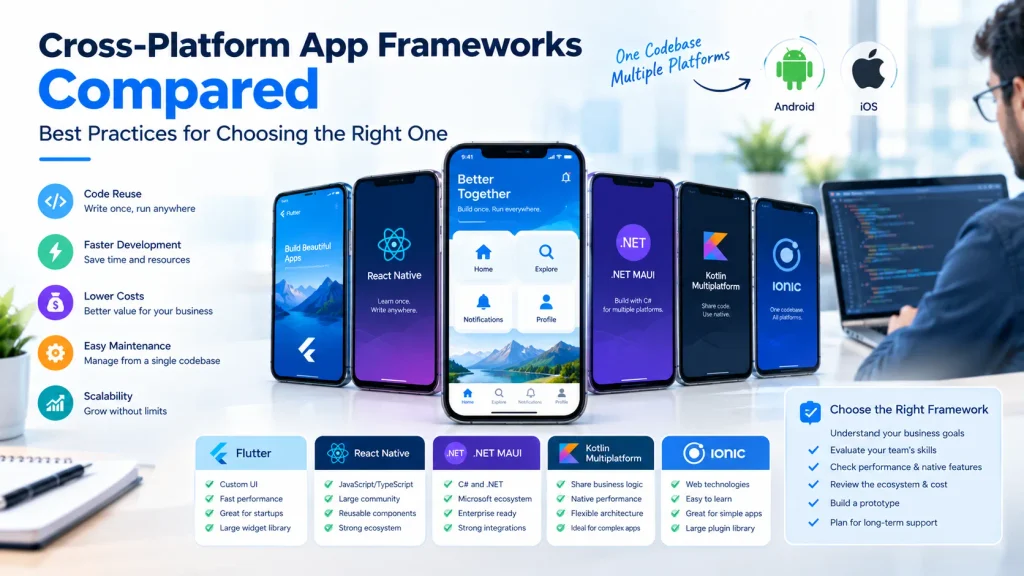
There is no single winner among cross-platform app frameworks.
The best framework depends on your business and technical requirements.
Choose Flutter If:
You want highly customized interfaces, a consistent visual experience, and a development approach centered around Flutter’s widget system.
Consider React Native If:
Your organization has strong JavaScript or TypeScript expertise and wants to benefit from the React ecosystem.
Consider .NET MAUI If:
Your business already has a strong Microsoft and .NET technology environment.
Consider Kotlin Multiplatform If:
You want to share important business logic while retaining strong native platform capabilities.
Consider Ionic If:
Your team already has strong web development skills and your application’s requirements fit a web-technology-based approach.
These recommendations are starting points, not universal rules.
A Practical Decision-Making Checklist
Before selecting one of the cross-platform app frameworks, answer these questions:
Business
- What problem does the application solve?
- Who are the users?
- What is the expected business value?
Platform
- Do we need Android?
- Do we need iOS?
- Will we need web or desktop support?
Technical
- What programming languages does our team know?
- What APIs and integrations are required?
- What native features are required?
Performance
- Does the app require real-time processing?
- Does it have demanding graphics?
- Does it handle large amounts of data?
Security
- What sensitive data will the app handle?
- What authentication is required?
- What security standards apply?
Maintenance
- Who will maintain the application?
- How often will it be updated?
- Can the team support the framework long term?
Budget
- What is the initial development budget?
- What is the expected maintenance budget?
- What additional infrastructure costs will exist?
Cross-Platform vs Native App Development
One of the biggest decisions is whether to use cross-platform app frameworks or develop separately for each platform.
| Factor | Cross-Platform | Native |
|---|---|---|
| Code Reuse | High | Low |
| Development Speed | Often faster | Usually slower across two platforms |
| Platform-Specific Control | Good to strong, depending on framework | Excellent |
| Maintenance | Centralized/shared in many areas | Separate codebases |
| Native Features | Strong, but may require platform code | Direct access |
| Team Requirements | Potentially smaller | Often requires platform specialists |
| Custom Performance | Depends on project | Maximum control |
Cross-platform development can be highly effective, but native development may be preferable when maximum platform-specific control or specialized performance is critical.
The Future of Cross-Platform Development
The mobile development industry continues to evolve.
Businesses increasingly want applications that can reach multiple platforms without maintaining completely separate systems for every environment.
At the same time, users expect:
- Fast performance
- Beautiful interfaces
- Strong security
- Reliable updates
- Consistent experiences
This means the future of cross-platform app frameworks will likely continue to focus on improving developer productivity while providing better access to native capabilities.
However, technology alone does not determine whether an app succeeds.
Product strategy, user experience, architecture, security, testing, and ongoing maintenance remain equally important.
Final Thoughts
Choosing among cross-platform app frameworks is not simply a technical decision. It is a business decision that can influence development costs, launch speed, product quality, maintenance requirements, and long-term scalability.
Flutter, React Native, .NET MAUI, Kotlin Multiplatform, and Ionic all offer different approaches to cross-platform development.
The best option depends on your application’s requirements, development team’s skills, target platforms, performance expectations, security needs, budget, and future plans.
Instead of asking:
“Which cross-platform framework is the best?”
Ask:
“Which framework is the best fit for our specific product?”
That change in perspective can lead to a much better technology decision.
Start by defining your requirements, compare the available cross-platform app frameworks, build a small prototype for difficult features, evaluate the development ecosystem, test real devices, and consider long-term maintenance.
When technology is selected based on actual business and user needs, cross-platform development can provide an efficient foundation for building modern mobile applications across multiple platforms.
Frequently Asked Questions
What are cross-platform app frameworks?
Cross-platform app frameworks are development technologies that allow teams to build mobile applications for multiple platforms using a shared codebase or shared development approach.
Which cross-platform app framework is best?
There is no universal best framework. Flutter, React Native, .NET MAUI, Kotlin Multiplatform, and Ionic each have different strengths, and the right choice depends on your project requirements.
Is Flutter better than React Native?
Neither is automatically better. Flutter can be attractive for highly customized interfaces, while React Native can be particularly useful for teams with JavaScript or TypeScript and React expertise.
Are cross-platform apps cheaper to develop?
They can reduce development effort because teams can reuse code across platforms, but the actual cost depends on application complexity, team expertise, integrations, testing, design, and maintenance.
Are cross-platform apps as good as native apps?
A well-designed cross-platform application can provide an excellent user experience. However, applications requiring highly specialized platform features or maximum platform-specific performance may benefit from native development.
Can cross-platform apps use native features?
Yes. Modern cross-platform approaches can access many native device capabilities, although some specialized features may require platform-specific code.
Is React Native suitable for business applications?
React Native can be suitable for many business applications, particularly when a company already has JavaScript, TypeScript, or React expertise.
Is Flutter good for startups?
Flutter can be attractive to startups because it can support rapid development and highly customized interfaces while targeting multiple platforms from a shared project.
Should I choose cross-platform or native development?
Choose based on your requirements. Cross-platform development may be a strong option when code reuse and multi-platform delivery are priorities, while native development may be better when maximum platform-specific control is essential.
How do I choose the right cross-platform app framework?
Evaluate your team’s skills, target platforms, UI requirements, performance needs, native features, security requirements, ecosystem, development cost, and long-term maintenance plans before making a decision.