
Subtotal ₨ 0
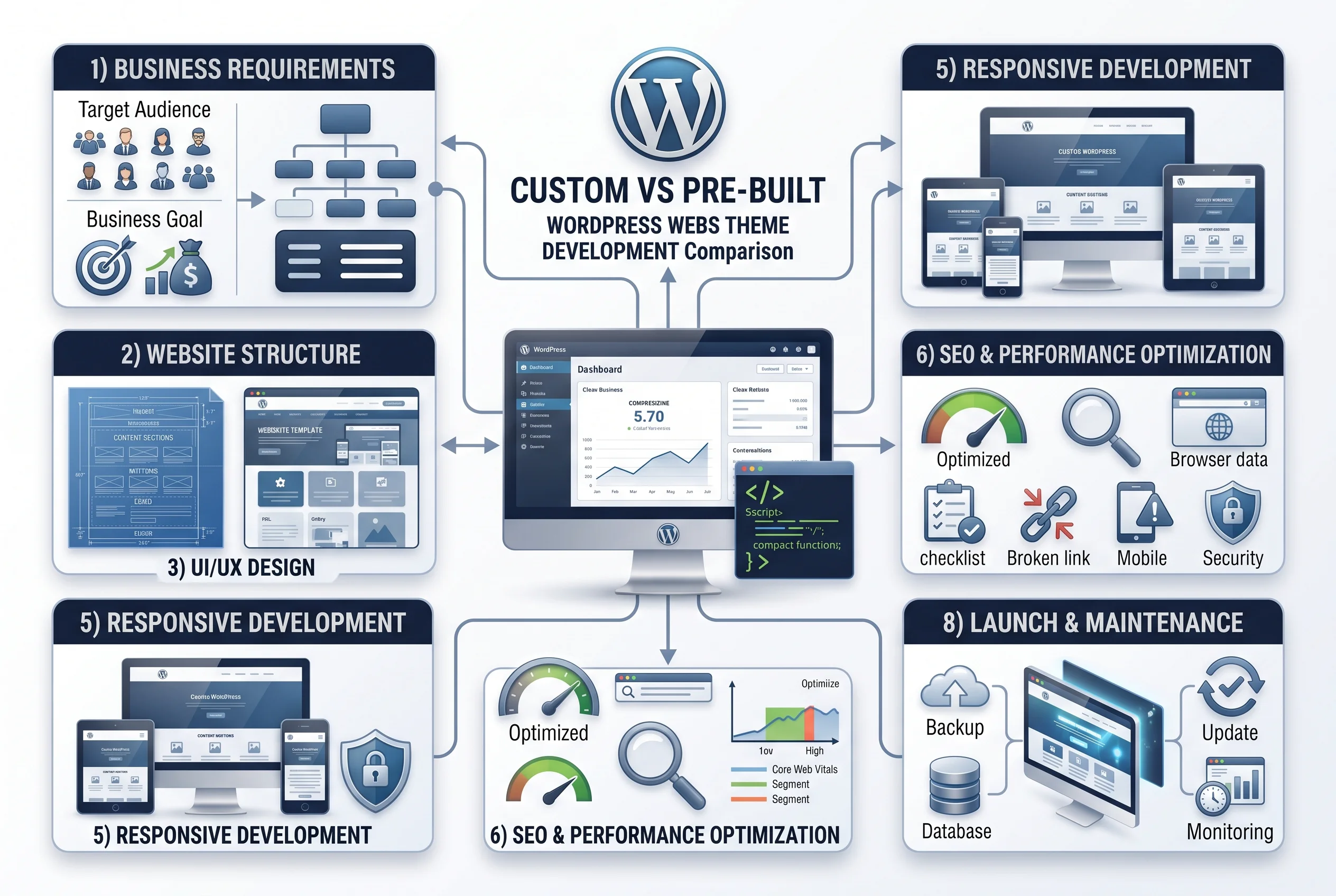
A professional website is more than a collection of pages, images, and text. It is an important part of a business’s digital identity. Custom WordPress theme development allows businesses to create websites that are specifically designed around their brand, goals, customers, and functionality instead of relying completely on a pre-built theme.
WordPress provides thousands of ready-made themes, making it easy to launch a website quickly. However, pre-built themes often include unnecessary features, design limitations, and layouts that are shared by many other websites. As a business grows, these limitations can become more noticeable.
With a custom WordPress theme, businesses can create a unique design, improve website performance, control the user experience, and build functionality according to their specific requirements.
This guide explains why custom WordPress theme development matters for businesses, its major benefits, potential challenges, development process, SEO advantages, performance considerations, and situations where a custom theme may be the right choice.
What Is Custom WordPress Theme Development?
Custom WordPress theme development is the process of designing and developing a WordPress theme specifically for a particular website or business.
Instead of selecting an existing theme and making limited changes, developers create the website’s structure, layout, styling, templates, and functionality according to the project’s requirements.
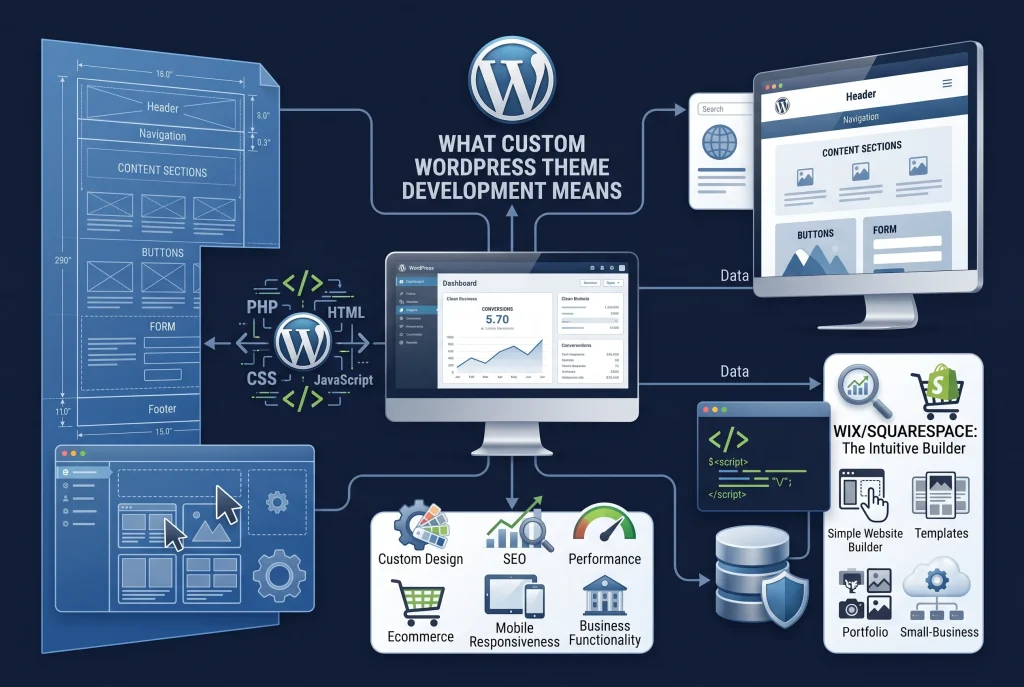
A custom theme can include:
- Custom homepage design
- Custom header and footer
- Custom navigation
- Blog layouts
- Custom page templates
- Custom post types
- Responsive layouts
- Brand-specific styling
- Custom widgets or blocks
- SEO-friendly structures
- Performance optimization
- Ecommerce integration
- Custom functionality
The main difference is control.
A pre-built theme gives you a predefined foundation, while custom development allows the website to be designed around the business.
Why Custom WordPress Theme Development Matters for Your Business
For businesses that want a professional and scalable online presence, custom WordPress theme development can provide several important advantages.
A website should not simply look attractive. It should communicate the brand, guide visitors, support marketing goals, perform well, and provide an experience that encourages users to take action.
A custom theme makes it possible to align these elements from the beginning.
1. Create a Unique Brand Identity
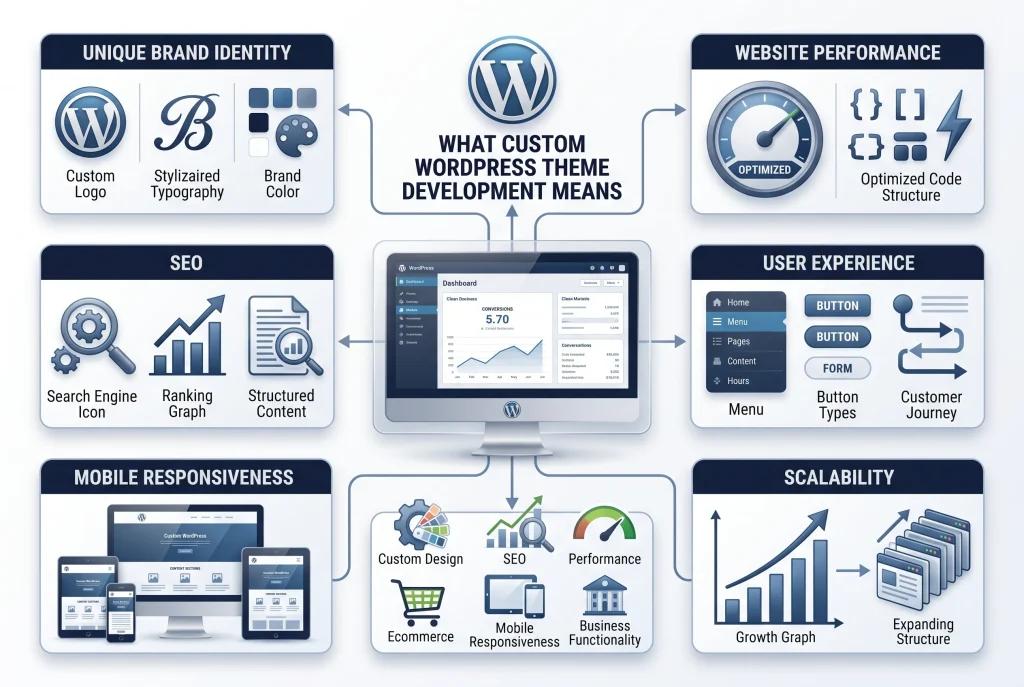
One of the biggest benefits of custom WordPress development is the ability to create a unique visual identity.
Many businesses use popular premium themes with similar layouts. Even after changing colors and logos, the overall structure can remain recognizable.
A custom WordPress theme can be designed around:
- Brand colors
- Typography
- Logo placement
- Photography style
- Graphic elements
- Button styles
- Navigation
- Content layouts
- Brand messaging
This helps create a consistent digital identity.
For example, a luxury brand may require a completely different visual experience from a technology company or local service business.
A custom theme allows the website design to reflect those differences.
2. Better Control Over Website Design
Pre-built themes usually provide customization options through theme settings or page builders.
Although these tools are useful, they may not provide complete control over every design element.
With custom WordPress theme development, developers can create layouts specifically for the business.
This means you can control:
- Page structure
- Content hierarchy
- Spacing
- Typography
- Navigation
- Responsive behavior
- Interactive elements
- Calls to action
- Product layouts
- Blog design
Instead of changing your business to fit the theme, the theme is designed to fit your business.
3. Improve Website Performance
Website performance directly affects user experience.
A common problem with multipurpose themes is that they may include many features that a particular business never uses.
Extra scripts, stylesheets, plugins, animations, widgets, and functionality can increase page size and affect loading speed.
A custom theme can be developed with only the required functionality.
Developers can focus on:
- Clean code
- Optimized assets
- Efficient CSS
- Efficient JavaScript
- Proper image handling
- Reduced unnecessary dependencies
- Lightweight templates
- Better page structure
This can help create a faster website.
However, custom development alone does not guarantee speed. Hosting, images, plugins, caching, databases, and third-party scripts also affect performance.
4. Better User Experience
A successful business website should make it easy for visitors to find information and complete important actions.
Those actions might include:
- Contacting the business
- Requesting a quote
- Purchasing a product
- Booking an appointment
- Signing up for a newsletter
- Reading an article
- Calling the business
- Submitting a form
A custom theme allows developers to design the user journey around these objectives.
For example, a service business may need prominent calls to action throughout its website, while an online publication may need a strong content discovery system.
This flexibility can improve usability and conversion opportunities.
5. Mobile-Friendly Design
A large percentage of website traffic comes from mobile devices.
A website that looks excellent on desktop but performs poorly on mobile can lose potential customers.
Custom theme development allows developers to design responsive layouts specifically for:
- Desktop
- Laptop
- Tablet
- Smartphone
Developers can control how navigation, images, columns, buttons, forms, and content sections behave at different screen sizes.
A responsive website should not simply shrink the desktop layout.
It should provide an appropriate experience for each device.
6. SEO-Friendly Website Structure
SEO should be considered during website development rather than added as an afterthought.
A custom WordPress theme can be built with a clean structure that supports search engine optimization.
Important considerations include:
- Semantic HTML
- Proper heading hierarchy
- Clean page structure
- Mobile responsiveness
- Fast loading
- Image optimization
- Internal linking
- Crawlable navigation
- Structured content
- Accessibility
A custom theme can also avoid unnecessary markup and functionality that may make the website more difficult to optimize.
However, remember that a custom theme does not automatically produce higher rankings.
SEO also depends on content quality, keyword targeting, backlinks, technical SEO, search intent, and ongoing optimization.
7. Greater Scalability
Businesses change over time.
A company may start with five pages and later need:
- A blog
- Ecommerce
- Membership functionality
- Customer portals
- Landing pages
- Booking systems
- Multiple content types
- Advanced search
- Marketing integrations
A custom theme can be developed with future expansion in mind.
This is particularly useful for businesses that expect their website to become an important part of their operations.
Instead of replacing the entire website when new requirements appear, developers may be able to extend the existing architecture.
8. Avoid Unnecessary Theme Features
Many multipurpose themes attempt to provide everything in one package.
They may include:
- Multiple sliders
- Portfolio systems
- Several page builders
- Large animation libraries
- Extra widgets
- Multiple layout systems
- Demo content
- Various integrations
While these features may look attractive, a business may only need a small percentage of them.
With custom WordPress theme development, the website can focus on the functionality that actually matters.
This can result in a cleaner development environment and potentially easier maintenance.
9. Easier Brand Consistency
Brand consistency is important across every customer touchpoint.
A custom theme can establish consistent:
- Colors
- Typography
- Buttons
- Icons
- Forms
- Spacing
- Images
- Content layouts
- Calls to action
This makes the website feel like a natural extension of the company’s brand rather than a generic website template.
10. Better Conversion-Focused Design
A business website should have a purpose.
For many companies, that purpose is generating leads or sales.
Custom theme development allows the design to be built around conversion goals.
For example, a service website may include:
Hero section → Services → Benefits → Testimonials → Case studies → CTA → Contact form
An ecommerce website may use:
Product image → Product information → Benefits → Reviews → Pricing → Add to cart → Related products
The exact structure can be customized according to customer behavior and business goals.
11. Better Integration With Business Tools
Modern businesses often use multiple digital tools.
A WordPress website may need to connect with:
- CRM systems
- Email marketing platforms
- Analytics tools
- Payment gateways
- Booking systems
- Social media
- Customer support systems
- Ecommerce platforms
- Marketing automation tools
A custom theme and development architecture can make it easier to integrate these requirements into the website’s overall experience.
12. Better Control Over WordPress Templates
WordPress themes use templates to control how different content types are displayed.
A custom theme can provide dedicated templates for:
- Homepage
- Blog archive
- Single blog posts
- Categories
- Search results
- Pages
- Services
- Products
- Testimonials
- Team members
- Portfolio projects
This provides greater control over how different sections of a business website work.
Custom Theme vs Pre-Built WordPress Theme
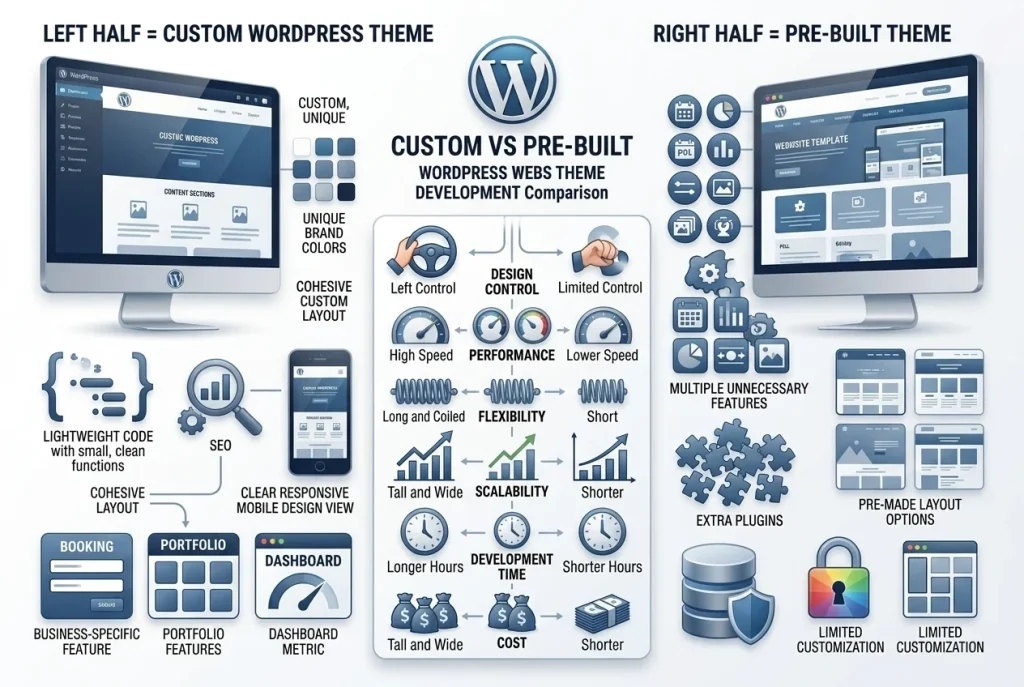
Before choosing custom development, businesses should understand the difference between custom and pre-built themes.
| Feature | Custom Theme | Pre-Built Theme |
| Unique design | Excellent | Limited |
| Customization | Very high | Moderate to high |
| Initial cost | Higher | Usually lower |
| Development time | Longer | Faster |
| Performance control | High | Depends on theme |
| Brand consistency | Excellent | Moderate |
| Scalability | High | Depends on theme |
| Technical control | High | Limited |
| Features | Business-specific | Often broad |
| Maintenance | Requires planning | Usually simpler initially |
A pre-built theme is not automatically bad.
For a small website with a limited budget, it may be the most practical solution.
Custom development becomes more valuable when the website has specific requirements or is expected to play an important role in business growth.
When Should a Business Choose a Custom WordPress Theme?
A custom theme may be appropriate when:
- Your brand requires a unique website
- Existing themes cannot meet your requirements
- Website performance is important
- You need custom functionality
- You expect significant future growth
- Your website generates leads
- You require advanced content structures
- You want complete design control
- You need specific integrations
- Your website is a major business asset
For a simple personal blog, a quality pre-built theme may be enough.
For a growing company, ecommerce brand, agency, publication, or large content website, custom development can provide significant long-term value.
When a Pre-Built Theme May Be Better
Custom development is not always necessary.
A pre-built theme may be better when:
- You have a limited budget
- You need a website quickly
- Your requirements are simple
- You do not need unique functionality
- You are testing a new business idea
- The website is temporary
- A reliable theme already meets your requirements
The goal is not to choose custom development simply because it sounds more professional.
The goal is to choose the solution that provides the best balance between requirements, budget, time, and long-term value.
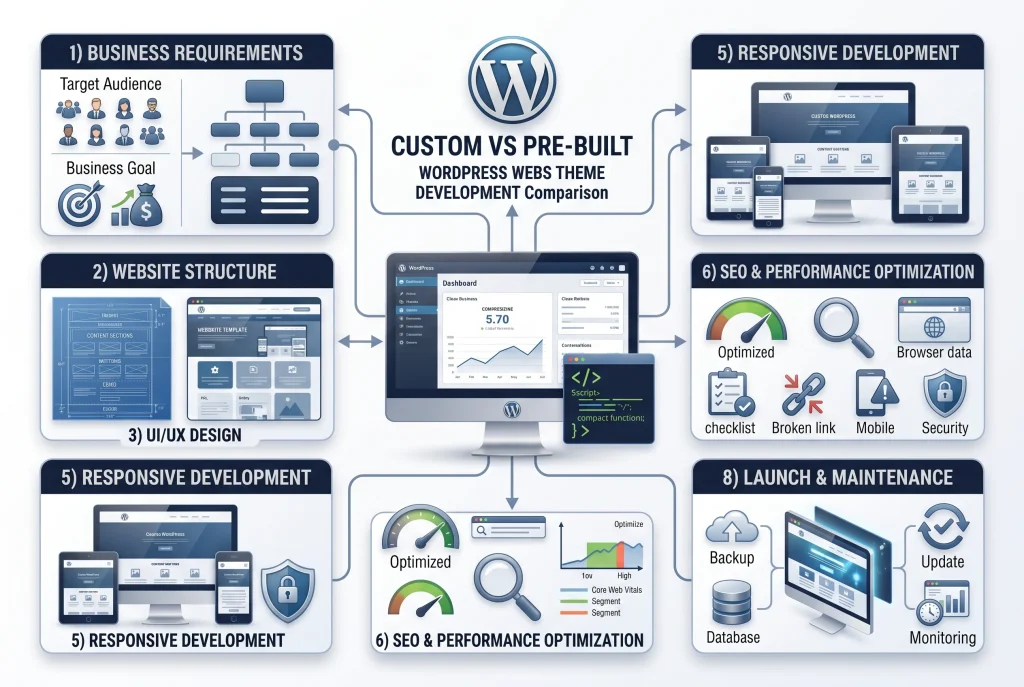
The Custom WordPress Theme Development Process
Professional custom theme development usually follows several stages.
Step 1: Business and Requirement Analysis
The first step is understanding the business.
Developers should identify:
- Target audience
- Business goals
- Required pages
- Desired functionality
- Content types
- Integrations
- SEO requirements
- Performance requirements
- Future expansion plans
Step 2: Website Structure
Next, the website structure is planned.
This may include:
- Navigation
- Page hierarchy
- Content architecture
- Categories
- User journeys
- Calls to action
A sitemap can help organize the website before design begins.
Step 3: UI/UX Design
The visual experience is then designed.
Designers consider:
- Typography
- Colors
- Layout
- Spacing
- Buttons
- Forms
- Navigation
- Mobile layouts
The goal is to create an interface that supports both branding and usability.
Step 4: Theme Development
Developers convert the approved design into a functional WordPress theme.
This can involve:
- HTML
- CSS
- JavaScript
- PHP
- WordPress functions
- Template files
- Custom blocks
- Theme configuration
Step 5: Responsive Development
The theme is tested across different screen sizes.
Developers verify:
- Navigation
- Images
- Typography
- Forms
- Buttons
- Columns
- Tables
- Content spacing
Step 6: SEO and Performance Optimization
The website is then optimized for:
- Page speed
- Mobile performance
- Semantic HTML
- Metadata
- Heading structure
- Images
- Core Web Vitals
Step 7: Testing
Before launch, the website should be tested for:
- Broken links
- Browser compatibility
- Mobile responsiveness
- Forms
- Security
- Performance
- Accessibility
- Plugin compatibility
Step 8: Launch and Maintenance
After testing, the website can be launched.
Ongoing maintenance should include:
- WordPress updates
- Security monitoring
- Backups
- Performance checks
- Content updates
- Plugin management
- Technical improvements
How Custom Themes Can Support Business Growth
A website should evolve alongside the business.
As traffic, content, products, and customers increase, website requirements may change.
A custom theme can provide a strong foundation for this growth.
For example, a business may initially need only a homepage, services page, about page, and contact page.
Later, it may add:
- Blog
- Lead magnets
- Landing pages
- Ecommerce
- Customer accounts
- Online booking
- Case studies
- Resources
- Knowledge base
A well-planned custom theme can make these additions easier to manage.
Common Mistakes in Custom WordPress Theme Development
Even custom development can go wrong if the project is poorly planned.
Building Without a Clear Strategy
Developing pages without understanding the business objective can produce a visually attractive but ineffective website.
Adding Too Many Features
Custom development should not become an excuse to add unnecessary functionality.
Every feature should have a purpose.
Ignoring Mobile Users
Mobile responsiveness should be part of the initial design and development process.
Neglecting Performance
A custom theme can still become slow if developers use inefficient code, large assets, unnecessary scripts, or poor implementation practices.
Ignoring SEO
SEO requirements should be considered during development rather than after launch.
Poor Documentation
Future developers need to understand how the theme works.
Clear documentation can make maintenance and future development easier.
How Much Does Custom WordPress Theme Development Cost?
The cost varies significantly depending on the project’s complexity.
A simple custom business theme will generally require less development than a large ecommerce website with custom functionality.
Factors affecting cost include:
- Number of pages
- Design complexity
- Custom functionality
- Integrations
- Ecommerce requirements
- API connections
- Animation
- Performance requirements
- SEO requirements
- Developer experience
- Testing requirements
Instead of selecting a developer solely based on the lowest price, businesses should evaluate quality, communication, experience, technical skills, and long-term support.
Is Custom WordPress Theme Development Worth It?
For the right business, yes.
The value comes from having greater control over the website’s design, functionality, performance, branding, SEO structure, and future growth.
However, custom development is not automatically the best choice for every website.
A small business with simple requirements may get better value from a reliable pre-built theme.
A business that depends heavily on its website for leads, sales, content marketing, or customer experience may benefit much more from a custom solution.
Final Thoughts
Custom WordPress theme development gives businesses the opportunity to create a website around their actual requirements instead of adapting their business to a pre-built design.
It can provide greater design control, stronger branding, better performance opportunities, flexible functionality, improved user experience, and a foundation for future growth.
The most important thing is to approach custom development strategically.
A successful custom WordPress website should not only look unique. It should load efficiently, work across devices, support SEO, guide users toward important actions, and provide a strong foundation for the business.
When these factors are considered from the beginning, a custom WordPress theme can become much more than a website design. It can become an important part of the business’s digital infrastructure and long-term growth strategy.