
Subtotal ₨ 0
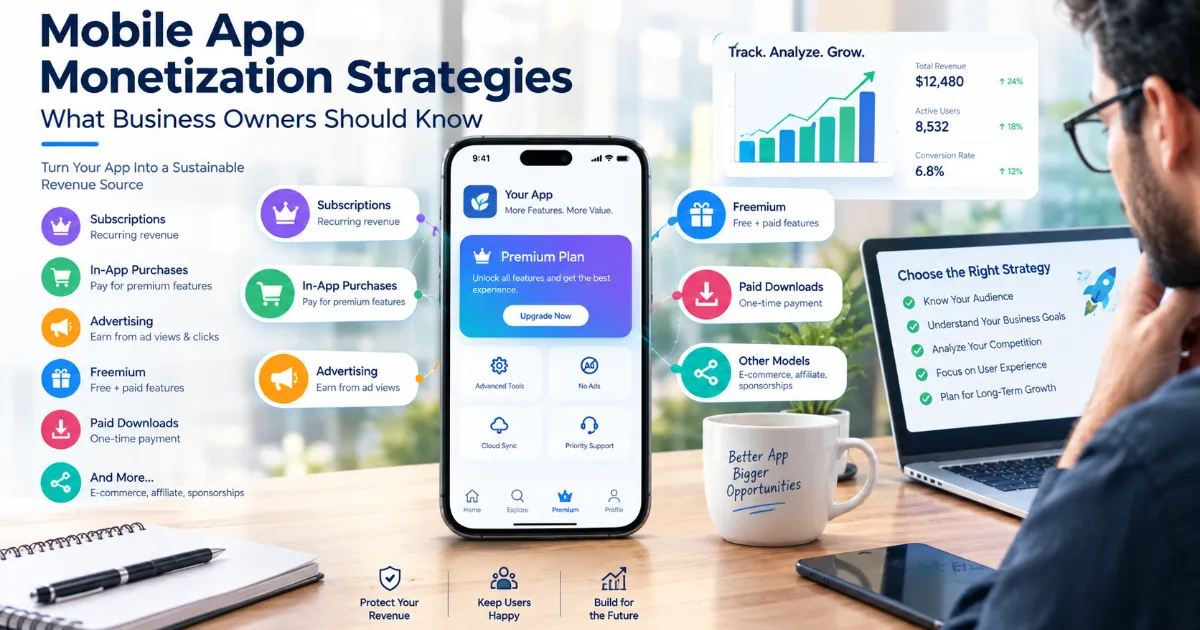
Building a mobile app can be a powerful way to reach customers, improve brand visibility, create new services, and generate revenue. But developing an app is only the beginning. Business owners also need a clear plan for turning their application into a sustainable source of income.
This is where mobile app monetization strategies become important.
An app may have thousands of downloads and still generate very little revenue if its business model is not properly planned. On the other hand, a smaller app with the right audience, pricing model, and user experience can become a profitable digital product.
The best monetization strategy depends on your target audience, industry, app type, pricing structure, user behavior, and long-term business goals.
In this guide, we explain the most important mobile app monetization strategies, how they work, their advantages and disadvantages, and what business owners should consider before choosing one.
What Is Mobile App Monetization?
Mobile app monetization is the process of generating revenue from a mobile application.
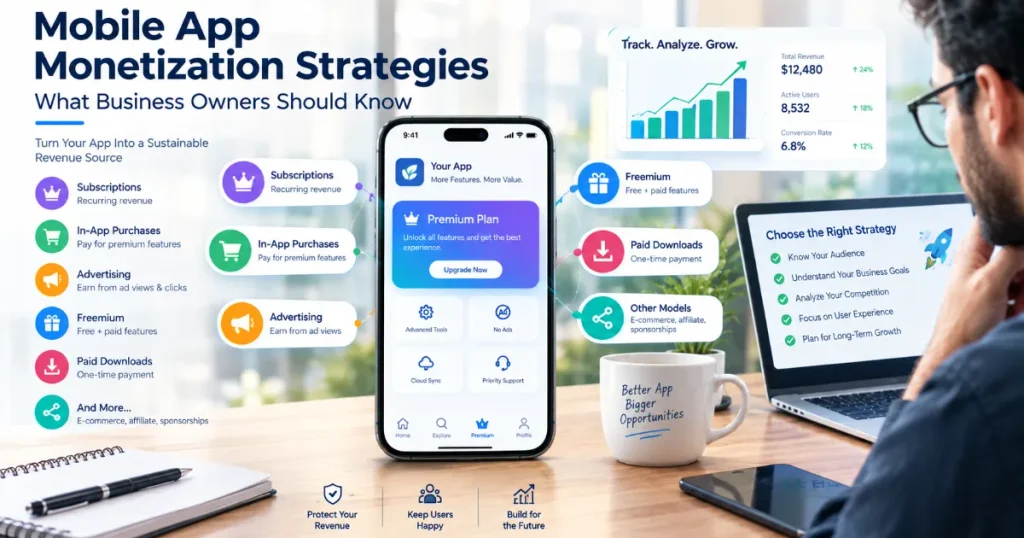
There are several ways an app can make money, including:
- Advertising
- In-app purchases
- Subscriptions
- Freemium plans
- Paid downloads
- Transaction fees
- Affiliate marketing
- Sponsorships
- E-commerce
- Premium features
- B2B licensing
The important point is that monetization should not be treated as something to decide after development.
A business should think about revenue during the planning stage.
Your monetization model can influence the app’s features, user interface, onboarding process, pricing page, payment system, analytics, and even backend architecture.
Why Mobile App Monetization Strategies Matter
Developing and maintaining an application requires investment.
Businesses may need to pay for:
- App design
- Development
- Backend infrastructure
- Cloud services
- Security
- Testing
- Marketing
- Customer support
- Updates
- Maintenance
Without a sustainable revenue model, these costs can become difficult to manage.
Effective mobile app monetization strategies help businesses recover development expenses and create recurring revenue that can support future improvements.
However, making money should not come at the expense of the user experience.
The best monetization strategy creates value for both the customer and the business.
1. Freemium Model
The freemium model is one of the most widely used mobile app monetization strategies.
Under this model, users can download and use the basic version of an app for free. Additional features are available through a paid upgrade.
For example, a productivity app might allow users to create a limited number of projects for free while offering unlimited projects through a premium plan.
Advantages of Freemium
- Easy for users to try
- Reduces the barrier to downloading
- Can generate a large user base
- Creates opportunities for upgrades
- Works well with digital products
Disadvantages of Freemium
- Many free users may never pay
- Premium features must provide genuine value
- Businesses need to balance free and paid functionality
- Supporting a large free user base can create costs
The key is deciding what users receive for free and what additional value justifies payment.
2. Subscription-Based Monetization
Subscriptions allow users to pay regularly for access to an application or premium service.
Common subscription periods include:
- Monthly
- Quarterly
- Annual
Subscriptions are particularly attractive for businesses because they can create recurring revenue.
Examples include:
- Fitness apps
- Learning platforms
- Productivity tools
- Streaming services
- Business software
- Premium content applications
Why Subscriptions Can Work Well
A subscription model gives businesses a more predictable revenue stream.
Instead of relying entirely on one-time purchases, the business can continue generating revenue as long as customers remain subscribed.
However, subscriptions also create a responsibility.
Users expect the application to continue providing value.
Regular updates, new features, quality content, customer support, and reliable performance can all influence whether users continue paying.
3. In-App Purchases
In-app purchases allow users to purchase individual products, features, digital items, or upgrades inside the application.
This approach is common in:
- Mobile games
- Entertainment apps
- Creative applications
- Dating apps
- Productivity tools
- Educational applications
For example, a gaming app might sell virtual items, while a photo editing application might sell premium filters or editing tools.
Benefits
- Users pay only for what they want
- Can generate additional revenue from free users
- Flexible pricing options
- Works well for digital products
Risks
Poorly designed in-app purchases can frustrate users.
Business owners should avoid making the free version unnecessarily difficult to use simply to force purchases.
The paid offering should provide meaningful additional value.
4. Advertising
Advertising is another common approach among mobile app monetization strategies.
Businesses can display advertisements within their applications and earn revenue based on impressions, clicks, or other advertising arrangements.
Common advertising formats include:
- Banner ads
- Interstitial ads
- Native ads
- Rewarded ads
- Video advertisements
Advertising can work particularly well when an app has a large number of active users.
Advantages of Advertising
- Users can access the app for free
- Can generate revenue at scale
- Suitable for high-traffic applications
- Can work alongside other monetization models
Disadvantages
Too many advertisements can damage the user experience.
For example, showing full-screen advertisements every few seconds can cause users to uninstall the app.
A better strategy is to place advertisements carefully and consider user behavior.
5. Rewarded Advertising
Rewarded advertising is a variation of the advertising model.
Instead of showing an advertisement without user choice, the application gives users something valuable in exchange for voluntarily watching an advertisement.
For example, a game might provide:
- Extra lives
- Virtual currency
- Bonus points
- Additional game time
after a user watches a video advertisement.
This model can create a better balance between revenue and user experience because users choose whether to participate.
6. Paid Apps
A paid app requires users to purchase the application before downloading or accessing it.
This is one of the simplest mobile app monetization strategies, but it can also create a significant barrier to downloads.
Users may hesitate to pay for an application they have never tried.
Paid apps are therefore often most suitable when:
- The value is immediately clear
- The app has a strong reputation
- The product serves a specific professional audience
- The application provides specialized functionality
For many consumer applications, a free download with optional premium features may attract more users.
7. Transaction Fees
Some applications make money by taking a percentage or fixed fee from transactions.
This model works particularly well for marketplaces and platforms.
Examples include apps that connect:
- Buyers and sellers
- Customers and service providers
- Freelancers and businesses
- Restaurants and customers
- Property owners and renters
For example, a marketplace could allow users to list products for free while charging a transaction fee when a sale occurs.
The advantage is that revenue is directly connected to the economic activity taking place on the platform.
8. E-Commerce Monetization
An application can also function as a mobile storefront.
Businesses can use apps to sell:
- Physical products
- Digital products
- Clothing
- Electronics
- Food
- Beauty products
- Services
E-commerce apps can combine several mobile app monetization strategies, such as product sales, subscriptions, memberships, and promotional offers.
The main advantage is that the app becomes part of the company’s broader sales system rather than depending on advertising revenue alone.
9. Affiliate Marketing
Affiliate marketing allows an app to earn a commission by referring users to another business.
For example, a travel application could recommend hotels or travel services and receive a commission when users make qualifying purchases through its referral system.
This approach can work well for:
- Travel apps
- Product recommendation apps
- Finance information apps
- Shopping applications
- Content platforms
The key requirement is trust.
Users should understand when recommendations involve affiliate relationships.
10. Sponsorships and Brand Partnerships
Businesses with a specific audience may generate revenue through sponsorships.
For example, a fitness application could partner with:
- Sports brands
- Nutrition companies
- Fitness equipment businesses
- Wellness services
A niche audience can be particularly valuable to sponsors because the audience may have a strong interest in a specific product category.
Sponsorship can therefore be an effective monetization option when an app has a clear and engaged audience.
11. Premium Features
Instead of charging users for the entire application, businesses can offer individual premium features.
For example, a free productivity app might provide:
- Basic task management
- Basic reminders
- Limited projects
while premium users receive:
- Advanced reports
- Unlimited projects
- Team collaboration
- Cloud synchronization
- Advanced automation
This approach gives users a reason to upgrade without requiring everyone to pay.
12. B2B and Enterprise Licensing
Not every application needs to make money directly from consumers.
Businesses can create applications for other businesses and charge licensing or service fees.
This can work particularly well for:
- Employee management systems
- Inventory applications
- Healthcare software
- CRM tools
- Field-service applications
- Educational platforms
- Business analytics tools
Enterprise customers may be willing to pay significantly more than individual consumers when the application solves an important business problem.
Mobile App Monetization Strategies Comparison
Different monetization models work for different types of applications.
| Monetization Strategy | Best For | Revenue Type | Main Advantage | Main Challenge |
|---|---|---|---|---|
| Freemium | Consumer & productivity apps | Upgrade revenue | Easy user acquisition | Low conversion |
| Subscription | SaaS, fitness, education | Recurring | Predictable revenue | Requires ongoing value |
| In-App Purchases | Games & digital products | Transactional | Flexible | Can frustrate users |
| Advertising | High-traffic free apps | Ad revenue | Free access | UX impact |
| Paid App | Specialized apps | One-time | Simple model | Download barrier |
| Transaction Fees | Marketplaces | Percentage/fee | Scales with activity | Requires transactions |
| E-commerce | Retail apps | Product sales | Direct revenue | Operational complexity |
| Affiliate | Recommendation apps | Commission | No inventory needed | Requires strong traffic |
| Sponsorship | Niche audiences | Partnership | High-value audience | Requires brand relationships |
| B2B Licensing | Business software | Contract revenue | High customer value | Longer sales cycle |
There is no single winner among mobile app monetization strategies.
The right model depends on your product and customers.
How to Choose the Right Monetization Strategy
Choosing a revenue model should begin with your users.
Ask:
Who is using the application?
Then ask:
What value does the application provide?
Finally:
What are users realistically willing to pay for?
For example, a fitness app might work well with subscriptions because users receive continuing access to workouts, tracking, and new content.
A marketplace may be better suited to transaction fees because revenue can be linked directly to successful transactions.
A casual game may combine free access, advertising, and in-app purchases.
The business model should naturally fit the product.
Understand Your Target Audience
One of the most important steps in evaluating mobile app monetization strategies is understanding your audience.
Consider:
- Age
- Location
- Purchasing power
- Usage frequency
- Customer needs
- Device usage
- Price sensitivity
- Willingness to subscribe
A monetization model that works for one audience may fail completely with another.
For example, professional users may be comfortable paying a monthly subscription for productivity software if it saves them time or increases business efficiency.
Casual users may be more comfortable with a free app supported by advertising.
Don’t Sacrifice User Experience for Revenue
One of the biggest monetization mistakes is trying to maximize revenue from every screen.
Users should not feel that the application is constantly asking them to pay.
Avoid:
- Excessive advertisements
- Aggressive pop-ups
- Misleading upgrade buttons
- Hidden costs
- Difficult cancellation processes
- Features that are unnecessarily restricted
A better strategy is to create a smooth experience and show premium options when they are relevant.
Good monetization should feel like an opportunity rather than a punishment.
Use Analytics to Improve Monetization
You cannot improve what you do not measure.
Analytics can help business owners understand how people interact with the app.
Important metrics may include:
- Downloads
- Active users
- Retention rate
- Conversion rate
- Subscription rate
- Average revenue per user
- Customer lifetime value
- Churn rate
- Advertising revenue
- In-app purchase revenue
For subscription apps, churn is especially important.
If many customers subscribe but cancel quickly, the problem may not be pricing. It may indicate that users do not see enough continuing value.
Understand Customer Lifetime Value
Customer lifetime value, often called CLV or LTV, estimates how much revenue a customer may generate during their relationship with the business.
For example, imagine an application charges $10 per month.
A customer who remains subscribed for 12 months could generate significantly more revenue than someone who subscribes for one month and cancels.
This is why businesses should think beyond the first purchase.
The goal is not simply to get users to pay once.
The goal is to create enough value that customers want to continue using the product.
Test Different Pricing Options
Pricing should not always be treated as permanent.
Businesses can test different:
- Subscription prices
- Free trial lengths
- Feature packages
- Premium tiers
- Annual discounts
- In-app purchase prices
For example, an application might offer:
Free
Basic functionality.
Pro
Advanced features for individual users.
Business
Additional collaboration and management tools.
This tiered approach can allow customers to choose the option that best fits their needs.
Monthly vs Annual Subscriptions
If you use a subscription model, consider offering both monthly and annual plans.
Monthly plans can provide flexibility.
Annual plans can encourage longer-term commitment and may reduce customer churn.
An annual plan can also make revenue more predictable.
However, pricing should remain transparent.
Users should clearly understand:
- What they are paying
- How frequently they are charged
- What features are included
- How cancellation works
- When renewal occurs
Transparency builds trust.
Free Trials: Are They Worth It?
A free trial can help users experience premium functionality before paying.
Free trials can work particularly well for applications where value becomes clear after regular use.
For example:
- Productivity software
- Fitness apps
- Educational applications
- Business tools
However, a free trial should have a clear purpose.
If users can understand the value of the application immediately, a shorter trial may be sufficient.
The goal is to let users experience the product rather than simply giving away premium functionality indefinitely.
Combine Multiple Monetization Strategies
Businesses do not always need to choose just one monetization method.
Some successful applications combine multiple models.
For example:
Free + Advertising + Premium Subscription
A user can access the basic application for free, see advertisements, or upgrade to remove ads and unlock additional features.
Another example is:
Free + In-App Purchases + Subscription
Users can purchase individual features while frequent users can choose a subscription for broader access.
Combining mobile app monetization strategies can diversify revenue, but it should not make the product confusing.
Keep the pricing structure simple.
Mobile App Monetization by App Type
Different applications naturally suit different revenue models.
| App Type | Potential Monetization Models |
|---|---|
| Fitness App | Subscription, premium content |
| Education App | Subscription, courses, premium features |
| Gaming App | Ads, in-app purchases |
| E-commerce App | Product sales, memberships |
| Marketplace | Transaction fees |
| Productivity App | Freemium, subscription |
| Finance App | Subscription, premium services |
| Travel App | Affiliate, bookings, advertising |
| Social App | Advertising, premium features |
| Business App | Subscription, licensing |
This does not mean you are limited to these options.
The best mobile app monetization strategies depend on your specific business model and customer behavior.
Common Mobile App Monetization Mistakes
Choosing Revenue Before Understanding Users
Do not start by asking how much you can charge.
Start by understanding what users need.
Too Many Ads
Excessive advertisements can damage retention and user satisfaction.
Making the Free Version Useless
If the free version provides no meaningful value, users may uninstall the app before discovering premium features.
Complicated Pricing
Too many plans can confuse customers.
Keep pricing easy to understand.
Ignoring Churn
Getting new subscribers is not enough if existing customers cancel quickly.
Hiding Costs
Unexpected charges damage trust.
Ignoring Analytics
Without data, businesses may make pricing decisions based on assumptions.
Focusing Only on Downloads
Downloads do not automatically equal revenue.
An app with fewer downloads but highly engaged paying users may be more profitable than an app with millions of inactive users.
How to Build a Profitable Mobile App
A profitable application usually combines several important elements:
Useful Product + Strong User Experience + Appropriate Monetization + Retention + Continuous Improvement
Start with a genuine customer problem.
Build a useful solution.
Make the application easy to use.
Then choose a monetization strategy that fits the value being provided.
After launch, measure user behavior and improve the product based on real data.
This approach is more sustainable than trying to maximize revenue immediately.
What Business Owners Should Discuss With an App Development Company
If you are hiring an app development company, discuss monetization before development begins.
Ask:
- Which monetization model fits our application?
- How will payments be implemented?
- What subscription features are needed?
- How will in-app purchases work?
- What analytics should be included?
- How will advertisements affect the design?
- How will the app handle cancellations?
- How will revenue-related data be tracked?
- What backend infrastructure is required?
Your development team should understand the business model because monetization can affect the technical architecture.
Monetization and App Design
Monetization should be included in the UI/UX design process.
For example, a subscription page should clearly communicate:
- Benefits
- Features
- Pricing
- Billing frequency
- Trial terms
- Cancellation information
Upgrade prompts should appear at logical moments.
For example, if a user tries to access an advanced feature, that may be a natural opportunity to explain the premium plan.
Good timing is more effective than constantly showing advertisements or upgrade messages.
Mobile App Monetization Strategies for Startups
Startups often have limited budgets, so monetization decisions are particularly important.
A practical approach may be:
Step 1: Launch a Minimum Viable Product
Build the essential features first.
Step 2: Attract Early Users
Focus on solving the problem effectively.
Step 3: Measure Engagement
Find out which features users actually value.
Step 4: Test Monetization
Experiment with subscriptions, premium features, advertising, or other suitable models.
Step 5: Improve Retention
Give customers reasons to continue using the application.
Step 6: Scale Revenue
Once the model is proven, invest in marketing and additional features.
This reduces the risk of spending heavily on a business model that customers do not want.
The Future of Mobile App Monetization
The mobile app economy continues to evolve.
Users are becoming more aware of subscriptions, privacy, advertisements, and recurring charges. At the same time, businesses have more tools for understanding customer behavior and personalizing digital experiences.
Future mobile app monetization strategies are likely to focus increasingly on:
- Personalization
- Subscription flexibility
- Better user experiences
- AI-powered features
- Premium digital services
- Loyalty programs
- Data-driven pricing
- Hybrid monetization models
However, one principle is unlikely to change:
Users pay for value.
The more clearly your application solves a meaningful problem, the easier it becomes to build a sustainable monetization model.
Final Thoughts
Choosing the right monetization strategy is one of the most important decisions a business owner can make when developing a mobile application.
There are many mobile app monetization strategies, including subscriptions, advertising, freemium models, in-app purchases, transaction fees, e-commerce, affiliate marketing, sponsorships, and B2B licensing.
The best option depends on your users, industry, application type, pricing expectations, and business goals.
Do not choose a monetization model simply because it is popular.
Instead, ask:
What value does our app provide, and what are our users willing to pay for?
Use analytics to understand customer behavior, test different pricing options, protect the user experience, and continuously improve your product.
Most importantly, remember that successful monetization is not about extracting as much money as possible from users.
It is about creating enough value that customers are happy to pay.
When your product, user experience, and monetization strategy work together, your mobile application can become more than a digital product. It can become a sustainable revenue-generating part of your business.
Frequently Asked Questions
What are the best mobile app monetization strategies?
Popular mobile app monetization strategies include subscriptions, freemium plans, in-app purchases, advertising, paid downloads, transaction fees, e-commerce, affiliate marketing, sponsorships, and B2B licensing. The best strategy depends on the app and its target audience.
Which monetization strategy is best for a mobile app?
There is no universal best option. Subscription models work well for apps that provide continuing value, while advertising may suit high-traffic free apps. Marketplaces may benefit from transaction fees, and games often use advertising and in-app purchases.
How do free apps make money?
Free apps can generate revenue through advertisements, premium subscriptions, in-app purchases, affiliate marketing, transaction fees, sponsorships, or paid upgrades.
Are subscriptions good for mobile apps?
Subscriptions can be effective when an app provides continuing value. They can create recurring revenue, but businesses need to maintain the product and continuously give users reasons to remain subscribed.
What is a freemium mobile app?
A freemium app provides basic features for free while charging users for premium features, additional functionality, or an upgraded experience.
How can I monetize an app without advertisements?
You can use subscriptions, premium features, in-app purchases, paid downloads, transaction fees, e-commerce, affiliate marketing, sponsorships, or B2B licensing instead of advertisements.
How important is user retention for mobile App monetization?
User retention is extremely important because long-term users generally provide more opportunities for subscriptions, purchases, advertising revenue, or other forms of monetization.
Should a startup charge for its app?
Not necessarily. Startups can begin with a free or freemium model to reduce the barrier to adoption, then introduce premium features or subscriptions once they understand what users value.
How do I know if my app monetization strategy is working?
Track metrics such as conversion rate, retention, churn, average revenue per user, customer lifetime value, subscription revenue, in-app purchases, and advertising revenue.
Can I use multiple monetization strategies?
Yes. Many apps combine approaches such as free access, advertising, subscriptions, and in-app purchases. However, the overall pricing and user experience should remain simple and transparent.