
Subtotal ₨ 0
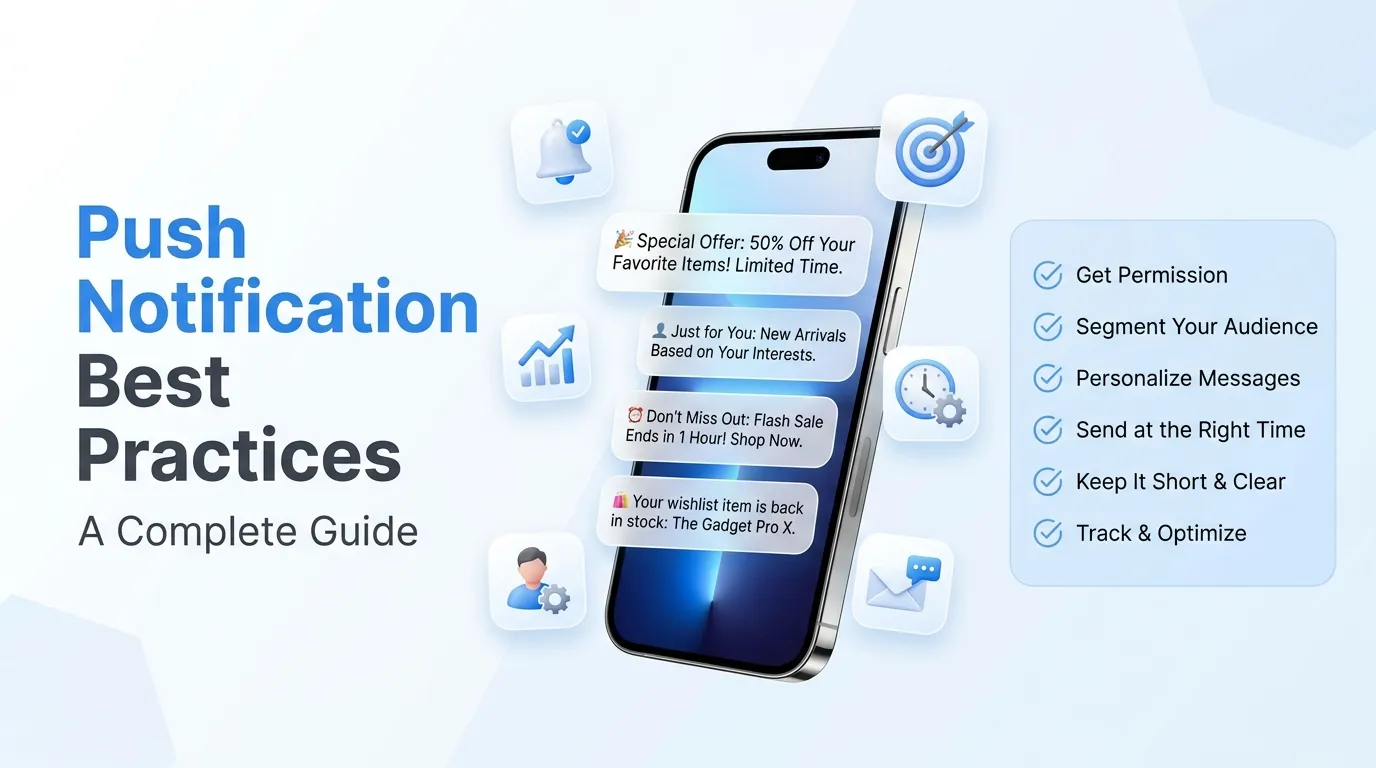
Push Notification Best Practices: A Complete Guide
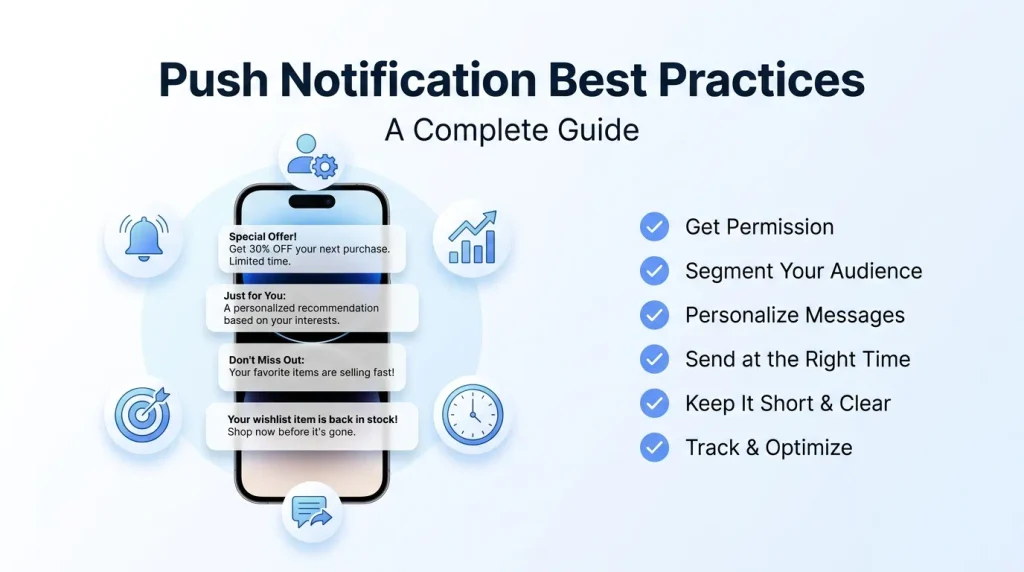
Push notifications are one of the most effective ways to re-engage users, deliver timely information, and increase conversions. But sending too many notifications—or sending the wrong message at the wrong time—can quickly cause users to disable notifications or uninstall an app.
Following the right push notification best practices helps businesses create messages that users actually want to receive. From personalization and timing to segmentation, copywriting, automation, and performance tracking, every part of your notification strategy can affect engagement.
In this complete guide, you’ll learn the most important push notification best practices for creating relevant, timely, and high-converting notification campaigns.
What Are Push Notifications?
Push notifications are short messages sent by websites, mobile applications, or other digital services directly to a user’s device.
They can be used to:
- Announce new products or features
- Remind users about abandoned carts
- Share breaking news and updates
- Promote limited-time offers
- Encourage users to return to an app
- Send personalized recommendations
- Confirm transactions or account activity
- Remind users about appointments or events
Unlike email, push notifications can appear directly on a user’s phone, desktop, or browser. This makes them a powerful real-time communication channel.
However, this direct access also means businesses need to use notifications responsibly.
That’s why understanding push notification best practices is essential for maintaining engagement without annoying your audience.
Why Push Notifications Matter
Push notifications can create an immediate connection between a business and its users.
When used strategically, they can improve:
- User engagement
- Retention
- Website traffic
- App sessions
- Product discovery
- Customer loyalty
- Conversions
- Revenue
The key is relevance.
A notification that provides useful information at the right moment can feel helpful. A notification that arrives too frequently or has no value can feel intrusive.
The best push notification best practices focus on delivering value first and promotional messages second.
15 Push Notification Best Practices You Should Follow
1. Get Permission Before Sending Notifications
The first rule of effective push notifications is simple: obtain user permission.
Don’t try to manipulate users into subscribing. Instead, explain what they will receive and why notifications could be useful.
For example:
Get instant updates about new products, special offers, and important account activity.
A clear permission request establishes expectations and can improve the quality of your subscriber base.
If users understand the benefit before opting in, they are more likely to remain engaged.
2. Segment Your Audience
Sending the same notification to every subscriber is one of the biggest mistakes businesses make.
Different users have different interests, behaviors, locations, and purchasing histories.
You can create segments based on:
- Location
- Age group
- Language
- Purchase history
- Browsing behavior
- Device type
- Subscription status
- Engagement level
- Product preferences
- Previous notification interactions
For example, an online store could send a sale notification for running shoes only to customers who previously viewed or purchased athletic products.
Audience segmentation is one of the most important push notification best practices because it makes messages more relevant.
3. Personalize Your Messages
Personalization can make a notification feel like a useful recommendation rather than a generic advertisement.
Instead of:
“Check out our latest products!”
Try:
“Your favorite running shoes are back in stock.”
Personalization can include:
- First name
- Recently viewed products
- Previous purchases
- Location
- Interests
- Browsing activity
- Recommended products
However, personalization should feel natural. Avoid using sensitive information or making users uncomfortable by revealing too much about what you know about them.
4. Write Short and Compelling Copy
Push notifications have limited space, especially on mobile devices.
Your message should communicate the most important information quickly.
A strong notification usually contains:
Hook + Value + Action
For example:
“20% off ends tonight. Shop your favorites before midnight.”
The message immediately communicates:
- The offer
- The urgency
- The action
Avoid unnecessary words, complicated explanations, and long paragraphs.
Concise copy is among the simplest push notification best practices to implement.
5. Use a Clear Call to Action
Every promotional notification should have a clear purpose.
Ask yourself:
What do I want the user to do after reading this notification?
Possible actions include:
- Shop now
- Read article
- Start free trial
- Complete checkout
- View offer
- Watch video
- Open app
- Claim reward
- Update account
Your CTA should be direct and aligned with the notification’s purpose.
6. Send Notifications at the Right Time
Timing can make or break a notification campaign.
A useful notification sent at the right time can generate strong engagement. The same notification sent at an inconvenient hour can frustrate users.
Consider:
- User time zone
- Local working hours
- User activity patterns
- Purchase behavior
- Day of the week
- Urgency of the message
For example, a food delivery app may send a lunch promotion around lunchtime rather than early in the morning.
The best push notification best practices consider the user’s schedule instead of simply following a fixed publishing time.
7. Don’t Send Too Many Notifications
Notification fatigue is a major problem.
If users receive several irrelevant notifications every day, they may:
- Ignore your messages.
- Disable notifications.
- Unsubscribe.
- Delete your application.
There is no universal perfect notification frequency. The right frequency depends on your industry, audience, and message type.
Focus on quality instead of quantity.
Before sending a notification, ask:
Does the user genuinely need or want this information right now?
If the answer is no, don’t send it.
8. Create Urgency Without Creating Anxiety
Urgency can increase engagement, but it should be authentic.
Good examples include:
- “Sale ends tonight.”
- “Only 2 hours left.”
- “Your reservation starts in 30 minutes.”
- “Early-bird pricing ends Friday.”
Avoid fake countdowns, misleading claims, or unnecessary fear.
Trust is more valuable than a temporary click.
9. Use Rich Media When Appropriate
Some platforms support images, emojis, buttons, icons, or other rich notification elements.
Visual content can make a notification more noticeable, particularly for:
- E-commerce promotions
- Travel offers
- Event announcements
- New products
- Content recommendations
However, rich media should support the message rather than distract from it.
If an image doesn’t add meaningful value, keep the notification simple.
10. Use Behavioral Triggers
Triggered notifications can be more relevant than manually scheduled campaigns.
Examples include:
Abandoned cart
“Still thinking about it? Your items are waiting in your cart.”
Inactive user
“We haven’t seen you lately. Here’s what’s new.”
Price drop
“Good news! An item on your wishlist is now on sale.”
Back in stock
“The product you wanted is available again.”
Post-purchase
“Your order has shipped.”
Behavior-based campaigns are powerful because the notification is connected to something the user actually did.
11. Test Different Messages
Don’t assume your first notification is your best notification.
Test different versions of:
- Headlines
- CTAs
- Offers
- Message length
- Emojis
- Images
- Delivery times
- Personalization
- Segments
A/B testing can reveal what your audience actually responds to.
For example:
Version A:
“20% off today. Shop now.”
Version B:
“Your favorites are 20% off today. Don’t miss out.”
Measure the results and use the winning version as a learning opportunity.
12. Use Deep Links
A notification should take users directly to the relevant destination.
If your notification promotes a specific product, don’t send users to the homepage and make them search for it.
Instead, use a deep link that opens:
- The specific product
- The relevant article
- The checkout page
- The user’s cart
- A particular app screen
- A personalized offer
Reducing the number of steps between the notification and the desired action can improve conversions.
13. Make Notifications Valuable
One of the strongest push notification best practices is to consistently provide value.
Value can mean different things depending on your business.
For example:
E-commerce: discounts, restock alerts, delivery updates
News: breaking stories and personalized headlines
Finance: transaction alerts and account updates
Education: study reminders and new lessons
Travel: flight updates and booking reminders
SaaS: important account notifications and product updates
When users consistently receive useful information, they’re more likely to keep notifications enabled.
14. Respect User Preferences
Give users control over what notifications they receive.
For example, allow subscribers to choose between:
- Promotions
- Product updates
- News
- Account alerts
- Recommendations
- Reminders
This creates a better user experience and reduces unnecessary opt-outs.
Respecting user preferences is an important part of sustainable notification marketing.
15. Track and Optimize Performance
You can’t improve what you don’t measure.
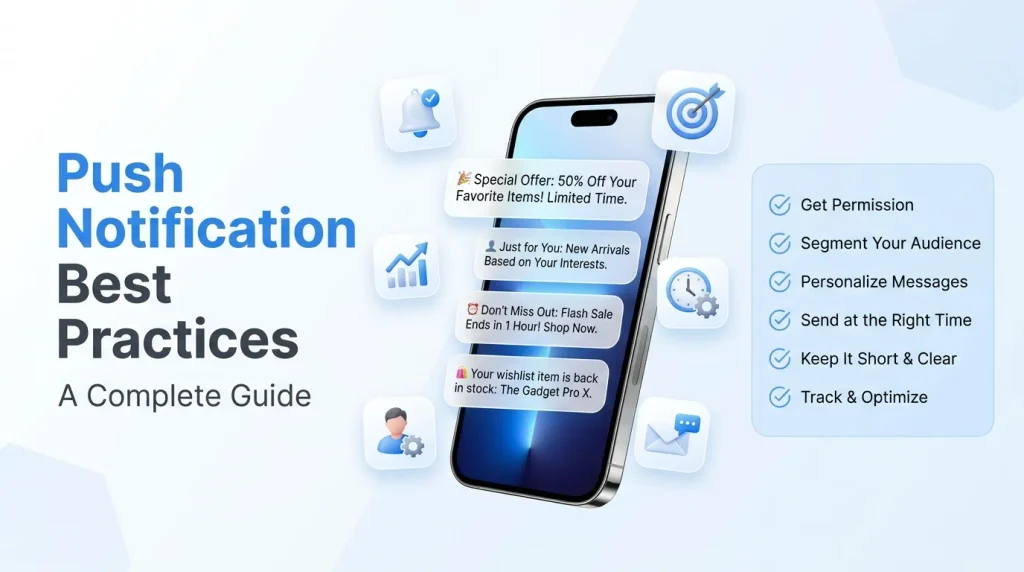
Important push notification metrics include:
Click-Through Rate
Measures the percentage of recipients who click the notification.
Conversion Rate
Shows how many users complete the desired action.
Opt-Out Rate
Shows how many users disable notifications.
Open Rate
Useful for platforms and notification types where open data is available.
Revenue Per Notification
Especially valuable for e-commerce and subscription businesses.
Retention
Helps determine whether notifications are bringing users back over time.
Don’t focus on clicks alone. A notification with a high click-through rate but poor conversions may not be delivering meaningful business results.
Push Notification Examples
Here are examples of effective notification messages for different industries.
E-commerce
“Your wishlist just got cheaper. Enjoy 20% off today.”
SaaS
“Your monthly report is ready. View your latest results.”
News
“Breaking: Major market update just announced.”
Travel
“Your flight departs tomorrow at 8:30 AM. Check your travel details.”
Education
“Your next lesson is ready. Continue learning.”
Food Delivery
“Hungry? Your favorite meal is just a tap away.”
Fitness
“Ready for today’s workout? Your 20-minute session is waiting.”
The best messages are specific, useful, and easy to understand.
Common Push Notification Mistakes to Avoid
Even if you follow most push notification best practices, certain mistakes can damage performance.
Sending Too Frequently
More notifications don’t automatically mean more engagement.
Using Generic Messages
Generic messages are less relevant and easier to ignore.
Ignoring Time Zones
A notification sent at 3 AM can quickly annoy users.
Using Clickbait
Misleading users may generate short-term clicks but damages long-term trust.
Forgetting Mobile Context
Users often see notifications while busy or distracted. Keep the message easy to understand.
Having Weak CTAs
Users should know exactly what to do next.
Not Measuring Results
Without analytics, you can’t determine which campaigns are working.
Treating Every Subscriber the Same
Segmentation is essential for relevance.
How to Build a Push Notification Strategy
A successful strategy doesn’t start with writing notifications. It starts with understanding your audience.
Follow this process:
Step 1: Define Your Goal
Decide whether you want to increase:
- Engagement
- Sales
- Retention
- App usage
- Content consumption
- Customer satisfaction
Step 2: Identify Your Audience
Create meaningful user segments based on behavior and preferences.
Step 3: Choose Notification Types
Determine which messages provide genuine value.
Step 4: Create the Message
Keep the copy concise, relevant, and action-oriented.
Step 5: Select the Right Timing
Consider user activity and time zones.
Step 6: Test
Experiment with different versions.
Step 7: Measure
Analyze clicks, conversions, opt-outs, and revenue.
Step 8: Optimize
Use your performance data to improve future campaigns.
This systematic approach turns notifications from random marketing messages into a measurable communication channel.
Push Notifications vs. Email
Push notifications and email serve different purposes.
| Feature | Push Notifications | |
|---|---|---|
| Delivery speed | Very fast | Usually slower |
| Message length | Short | Long-form |
| Visibility | High | Depends on inbox |
| Personalization | High | High |
| Best for | Timely actions | Detailed communication |
| User attention | Immediate | Delayed |
The two channels work particularly well together.
For example, an e-commerce company could use email for a detailed product promotion and push notifications for reminders or limited-time updates.
How Often Should You Send Push Notifications?
There is no single number that works for every business.
Your ideal frequency depends on:
- Industry
- User expectations
- Notification type
- Audience behavior
- Message value
- Customer lifecycle stage
Transactional notifications can be sent whenever necessary because they provide important information.
Promotional notifications should be more carefully controlled.
A good rule is to ask whether each notification provides enough value to justify interrupting the user’s attention.
How to Improve Push Notification Conversion Rates
If your notifications are receiving clicks but not conversions, examine the complete user journey.
Check:
- Is the notification relevant?
- Does the CTA match the message?
- Does the landing page load quickly?
- Does the landing page match the notification?
- Is the offer clear?
- Is the checkout process easy?
- Are users being sent to the correct page?
Conversion optimization doesn’t stop when someone clicks a notification.
The entire experience needs to be consistent.
Push Notification Best Practices Checklist
Before sending a campaign, use this checklist:
- User permission has been obtained.
- The audience is properly segmented.
- The message provides clear value.
- Personalization is used where appropriate.
- The copy is concise.
- The CTA is clear.
- The timing is appropriate.
- The notification isn’t unnecessarily frequent.
- Links lead to the correct destination.
- The campaign has measurable goals.
- A/B testing is being considered.
- Analytics are configured.
- User preferences are respected.
- The campaign complies with applicable privacy and marketing requirements.
Frequently Asked Questions
What are the most important push notification best practices?
The most important practices include obtaining permission, segmenting users, personalizing messages, sending notifications at appropriate times, limiting frequency, using clear CTAs, testing campaigns, and tracking performance.
How long should a push notification be?
Keep push notifications concise. The ideal length depends on the device and platform, but users should understand the message and its value without needing to open it.
How frequently should businesses send push notifications?
There is no universal frequency. Send notifications when they provide meaningful value, and adjust frequency based on engagement and opt-out data.
Are personalized push notifications more effective?
Personalization can improve relevance and engagement when it is based on appropriate user information and preferences. Avoid personalization that feels intrusive.
What is the best time to send a push notification?
The best time depends on your audience, location, behavior, and notification type. Analyze historical engagement data and test different delivery times.
How can I reduce push notification unsubscribes?
Reduce irrelevant messages, control notification frequency, improve segmentation, personalize appropriately, and give users control over the types of notifications they receive.
Should every push notification include a CTA?
Promotional notifications generally benefit from a clear CTA. However, informational or transactional notifications may not always require a traditional marketing CTA.
How do I measure push notification success?
Track metrics such as click-through rate, conversion rate, opt-out rate, engagement, retention, and revenue. The most important metric depends on your campaign objective.
Final Thoughts
Push notifications can be an incredibly effective communication and marketing channel when they’re used thoughtfully.
The most successful strategies don’t focus on sending more notifications. They focus on sending better notifications.
By following these push notification best practices, businesses can create messages that are timely, personalized, relevant, and useful. Start with permission and segmentation, create concise messages, choose the right timing, test different approaches, and continuously analyze performance.
Most importantly, remember that every notification competes for the user’s attention.
Provide value, respect their preferences, and give them a reason to keep your notifications enabled.
That is the foundation of a successful push notification strategy.