
Subtotal ₨ 0

If you are building a product without talking to your users, you are just guessing. A proper user research methods guide is the foundation of every successful digital product. It helps you move from assumptions to evidence and build things people actually want to use.
Many beginners feel overwhelmed by UX research. They think it is expensive, complex, and time-consuming. In reality, getting started is simpler than you think. With the right methods and mindset, you can uncover powerful insights even on a small budget.
In this complete guide, we will walk you through exactly how to get started with user research methods, step-by-step.
What Is a User Research Methods Guide and Why It Matters?
A user research methods guide is a structured framework that outlines different techniques for understanding user behaviors, needs, and motivations. It is not just a list of methods. It is your roadmap for making user-centered decisions.
Without research, you risk building features no one needs. You waste time, money, and development effort. User research validates your ideas before you invest heavily in design and code. It reduces risk and increases your product’s chance of success.
Great products are not built for users; they are built with users. This guide ensures you do exactly that from day one.
The 2 Main Types of User Research Methods You Must Know
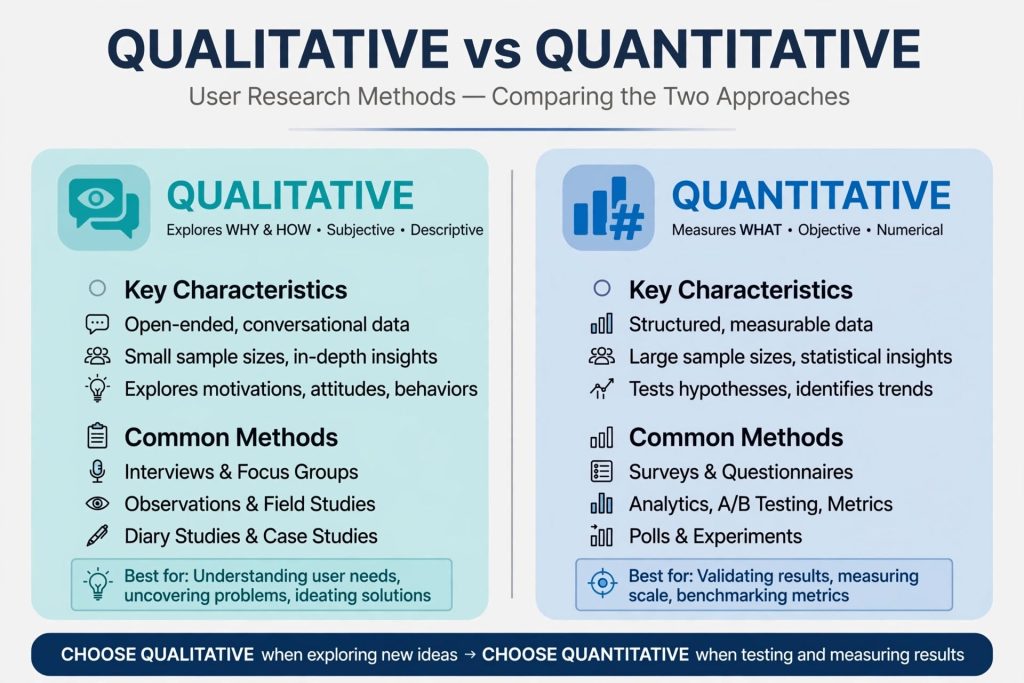
Before you start, you need to understand the two core categories. Every method in your user research methods guide will fall into one of these.
1. Qualitative Research Methods
Qualitative research helps you understand the why behind user behavior. It focuses on observations, thoughts, and feelings. This type of research provides deep, rich insights but with smaller sample sizes.
Common qualitative methods include user interviews, focus groups, and ethnographic field studies. These methods are perfect in the early stages when you want to explore a problem space and discover unmet needs.
2. Quantitative Research Methods
Quantitative research helps you understand the what and how many. It focuses on numbers, statistics, and measurable data. It provides validation at scale with larger sample sizes.
Common quantitative methods include surveys, A/B testing, and analytics analysis. These are ideal when you need to validate a hypothesis or measure usability issues across hundreds of users.
The best product teams use a mix of both. Start qualitative to explore, then use quantitative to validate.
7 Powerful Steps to Get Started with Your User Research Methods Guide
Ready to conduct your first research? Follow this proven 7-step process to ensure your research is effective and actionable.
Step 1: Define Your Research Goals Clearly
Never start research without a clear goal. What do you want to learn? Are you trying to understand why users are dropping off at checkout? Or are you exploring a new market opportunity?
Write down 1-3 specific research questions. For example: “What are the biggest frustrations users face when booking an appointment on our app?” Clear goals prevent scope creep and keep your research focused.
Step 2: Choose the Right Method for Your Goal
Your goal dictates your method. Do not just pick a method because it is popular.
If you need deep understanding of user motivations, choose user interviews. If you need to understand how users navigate your product, choose usability testing. If you need feedback from many users quickly, choose a survey. Your user research methods guide should be flexible, not fixed.
For beginners, we recommend starting with 1-on-1 user interviews. They are low-cost and provide incredibly rich insights.
Step 3: Recruit the Right Participants
Research with the wrong users is worse than no research at all. Define your ideal participant profile. Consider demographics, behaviors, and experience level.
You need 5-8 participants for qualitative studies to uncover 80% of major issues. Use screening surveys to filter candidates. You can recruit from your existing user base, social media, or platforms like UserTesting and Respondent.io.
Always offer a small incentive for their time. It shows respect and improves participation rates.
Step 4: Create Your Research Plan and Script
A research plan is your single source of truth. It should include your goals, methods, timeline, participants, and the tasks or questions you will ask.
If you are conducting interviews, write a discussion guide, not a rigid script. Start with broad, open-ended questions. Avoid leading questions like “Don’t you think our new feature is helpful?” Instead, ask “How do you currently solve this problem?”
Keep your tasks realistic and task-based for usability testing.
Step 5: Conduct the Research Effectively
During the research, your job is to listen, not to sell. Create a comfortable environment for participants. Make them feel safe to share negative feedback.
Use the 80/20 rule: listen 80% of the time and talk only 20%. Ask follow-up questions like “Can you tell me more about that?” to dig deeper. Record your sessions (with permission) so you can focus on the conversation instead of taking notes.
Do not interrupt or defend your design. You are there to learn.
Step 6: Analyze and Synthesize Your Findings
Raw notes are not insights. After your sessions, you need to analyze the data. Use affinity mapping to group similar observations together.
Look for patterns, themes, and surprising behaviors. Create user personas or journey maps based on what you learned. The goal is to turn scattered observations into clear, actionable takeaways that the whole team can understand.
Tools like Miro, Dovetail, or even sticky notes on a wall work perfectly for this.
Step 7: Share Insights and Take Action
Research is useless if it stays in a document. Share your findings with stakeholders through a concise presentation or report.
Focus on the most critical insights and include video clips or direct user quotes. They are far more persuasive than statistics alone. End with clear recommendations. What should the team build, fix, or test next based on this research?
This is how your user research methods guide creates real business impact.
Essential Tools for Your User Research Methods Guide Toolkit
You don’t need expensive tools to start. For interviews and usability testing, you can use Zoom or Google Meet with screen sharing. For recording and analysis, try Otter.ai for transcription.
For surveys, Google Forms or Typeform are excellent free options. For analytics, Google Analytics and Hotjar give you quantitative data on user behavior. For organizing findings, use Notion or Miro.
Start simple and upgrade your toolkit as your research practice matures.
Common Mistakes to Avoid When Starting User Research
One common mistake is asking users what they want. Users are great at identifying problems but not always at designing solutions. Focus on their problems and behaviors, not their feature requests.
Another mistake is only researching once. User research is not a one-time phase. It should be continuous throughout your product lifecycle. Build a habit of talking to at least 2-3 users every week.
Finally, avoid confirmation bias. Do not look only for evidence that supports your existing ideas. Be open to being wrong. That is where real learning happens.
Conclusion
Getting started with user research does not have to be intimidating. With this user research methods guide, you now have a clear, actionable framework to begin. Remember to start small, stay curious, and always focus on the user.
By following these seven steps consistently, you will build products that are not only usable but truly loved by your users. The insights you gather today will save you months of rework tomorrow.
Ready to transform your design process with real user insights?